If you are comparing image to stl tools, this review shows how Tripo and SupaVoxel differ in credit usage, upfront pricing, generation speed, consistency, and the practical results of turning one photo into a printable model.
Independent review: both products were tested on my own accounts — free where offered and paid where not — with no vendor-provided access.
My verdict in 60 seconds — Tripo 58/100, SupaVoxel 90/100
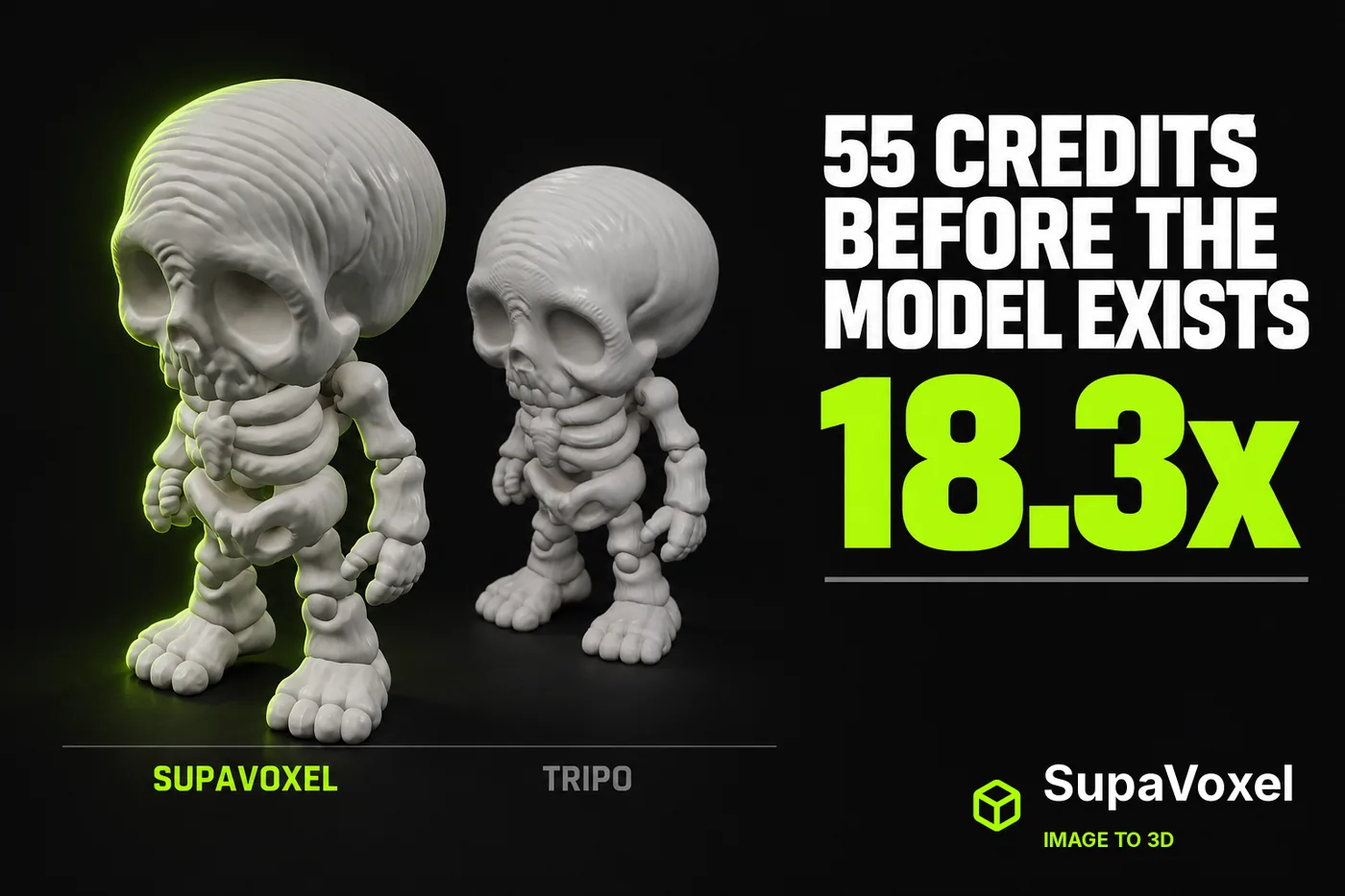
One photo of a ball-jointed toy skeleton, one generation on each product's stock defaults. Tripo billed 55 credits. SupaVoxel billed 3. That is 18.3×, for two files that print into the same object at the same resin cost. Tripo wins a real row here, and not the one I expected: not speed — SupaVoxel was quicker on this skeleton and on most subjects I ran — but consistency. Tripo lands in a 135–189 s window every time; SupaVoxel's slowest run took 867 seconds.
- Credits, one model — Tripo 55 · SupaVoxel 3 · 18.3×, same input, both on defaults
- When you are charged — Tripo at submit (balance moved while the card still read Generating) · SupaVoxel not captured
- Price shown before you click — Tripo no, appears only after upload · SupaVoxel yes, "Generate (3 credits)" on the button
- Rationed switches — Tripo 3 (Clean Topology ×2, Generate in Parts ×1, 8K Texture ×1) · SupaVoxel 0
- Wall-clock, this skeleton — Tripo 141.0 s · SupaVoxel 115.7 s · SupaVoxel took this one by 25 s
- Wall-clock, median of ten subjects — Tripo 163.5 s · SupaVoxel 133.6 s · SupaVoxel is usually faster, 7 of 10 subjects
- Wall-clock, worst case of ten — Tripo 189 s · SupaVoxel 867.4 s · Tripo is far more predictable — 54 s of spread against 767 s
- Batch of 100 — Tripo 5,500 credits · SupaVoxel 300 credits · 5,200 credits apart
- Batch of 100, resin — Tripo $427.00 · SupaVoxel $424.00 · $3.00 apart on 100 finished pieces
Five things about Tripo's meter that only show up when you watch the header:
- Tripo moved the balance 750 → 695 while the card still said "Generating… 106s". The money goes before the goods arrive.
- Tripo prints no price until the upload finishes. The button is blank, then it becomes "Generate ⊙ 55".
- Tripo's Clean Topology switch — the one governing topology quality — is off by default and capped at Trial ×2. The 55 credits bought the version with it off, and the winding defect I measured offline sits exactly there.
- Tripo's Generate in Parts is Members Only, Trial ×1, greyed out. On a ball-jointed skeleton that is the most relevant feature in the product, and 55 credits does not reach it.
- Tripo gives no completion timestamp, and its on-card counter counts down (106 → 83 → 29) — a remaining-time estimate, not elapsed time. 141 s is the best a stopwatch can do.
For anyone producing more than one of these, SupaVoxel is the cheaper path by a wide margin: 300 credits instead of 5,500 for a hundred pieces, $3.00 of resin between the batches.
The price is on the button before you touch anything
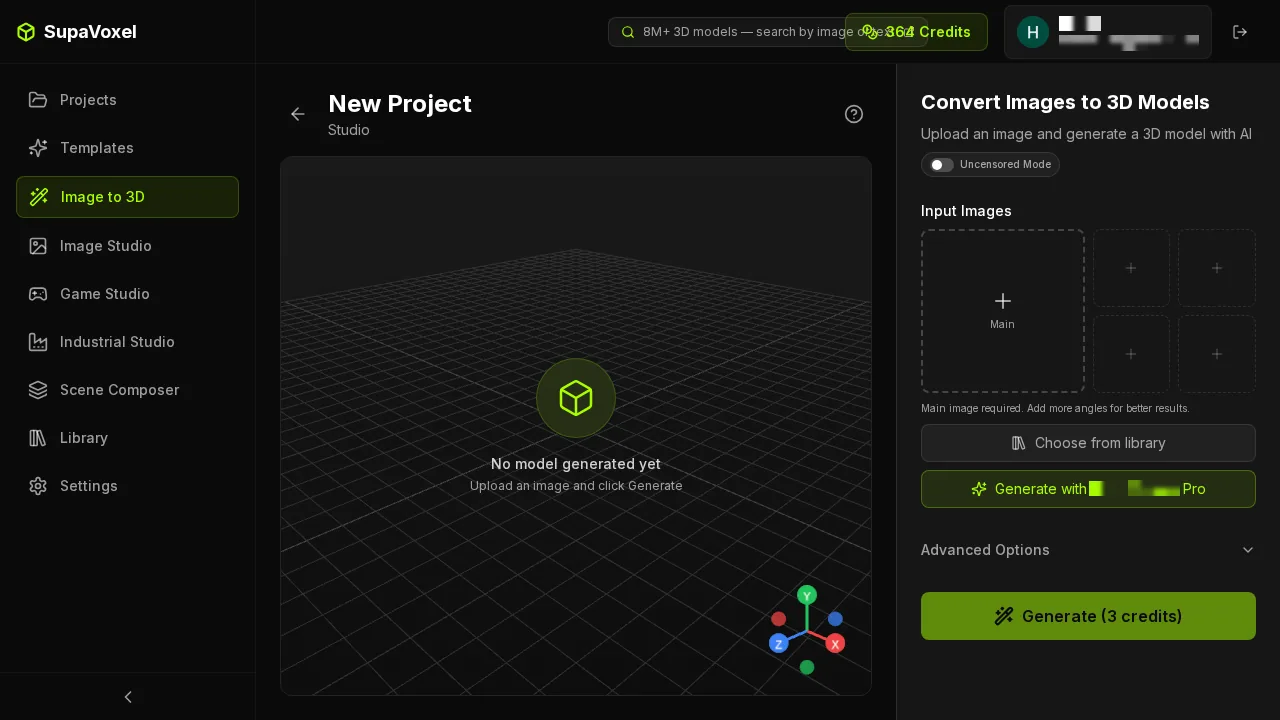 SupaVoxel's empty studio already reads "Generate (3 credits)", header balance 364. No Trial ×N badge anywhere; Advanced Options is a collapsible section, not a membership gate.
The whole price of the run is legible before any file is uploaded. Second-order number: 3 credits, fixed, 0 rationed switches in the panel — against Tripo's 55 and Tripo's three.
Tripo's first screen shows two popups and no price
 Tripo's studio on arrival: a purple "Level up your personal brand" bubble top right, a full cookie-consent panel bottom right covering the left half of the Generate button, and a Clean Topology Trial ×2 badge under the upload box.
Tripo shows the badge for a rationed feature before it shows the job's price. The cookie panel physically overlaps the primary action.
Tripo's price appears only after the upload
 After the image lands, Tripo's button becomes "Generate ⊙ 55". One upload slot, no second-view slot.
55 credits, revealed at the last possible moment. SupaVoxel's button carried its 3 credits from the moment the page loaded — an 18.3× difference, disclosed 18.3× earlier.
Five reference slots against Tripo's one
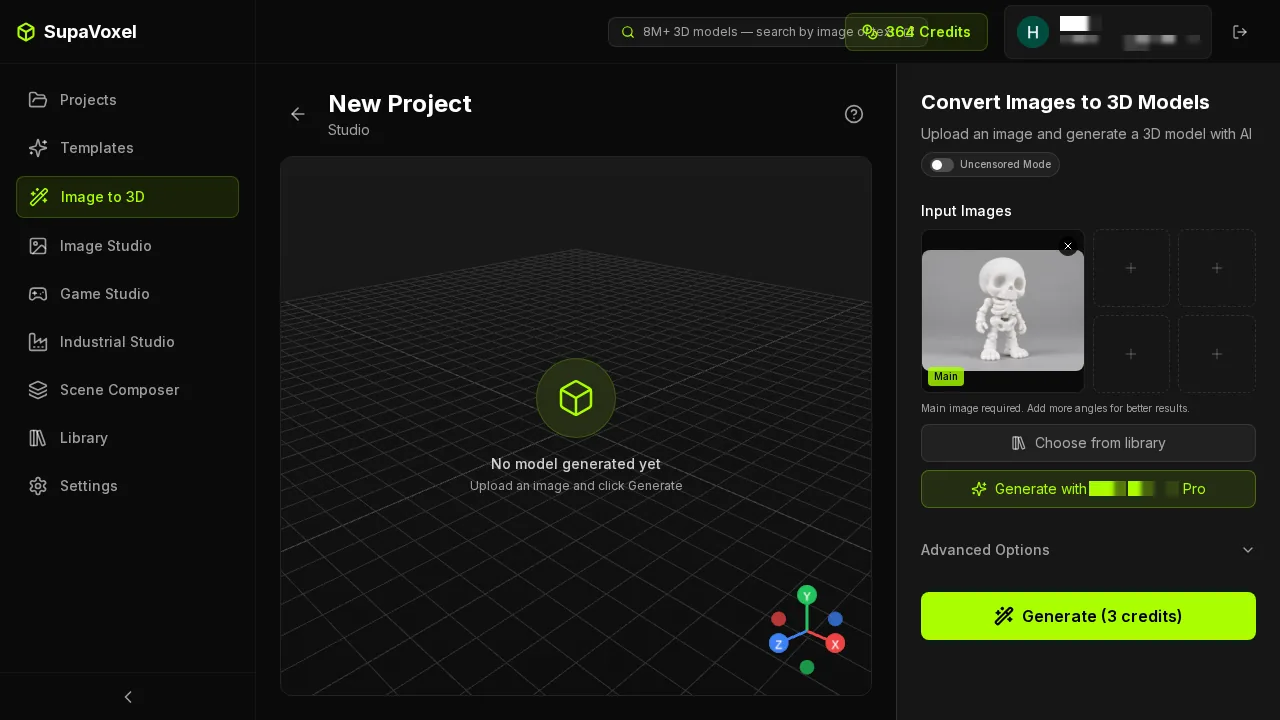 The main slot is filled and four empty slots sit beside it — SupaVoxel accepts 5 reference images; this case used 1. The thumbnail carries a Main tag and an × to withdraw it.
Tripo's upload area holds exactly one image. Where the back of the subject was never photographed, extra viewpoints are the cheapest possible fix, and Tripo has nowhere to put them — at any credit price.
The switch that decides topology is rationed at Trial ×2
 With the popups dismissed: Best Quality is the selected tier, Clean Topology sits beside it with a Trial ×2 badge, unchecked.
I submitted in exactly that state, because it is Tripo's default. So 55 credits bought a mesh generated without topology cleaning, and the inconsistent face winding I measured offline is the consequence. Second-order number: 2 — the times Tripo will ever let this account try the alternative.
Tripo takes the 55 credits while the card still says Generating
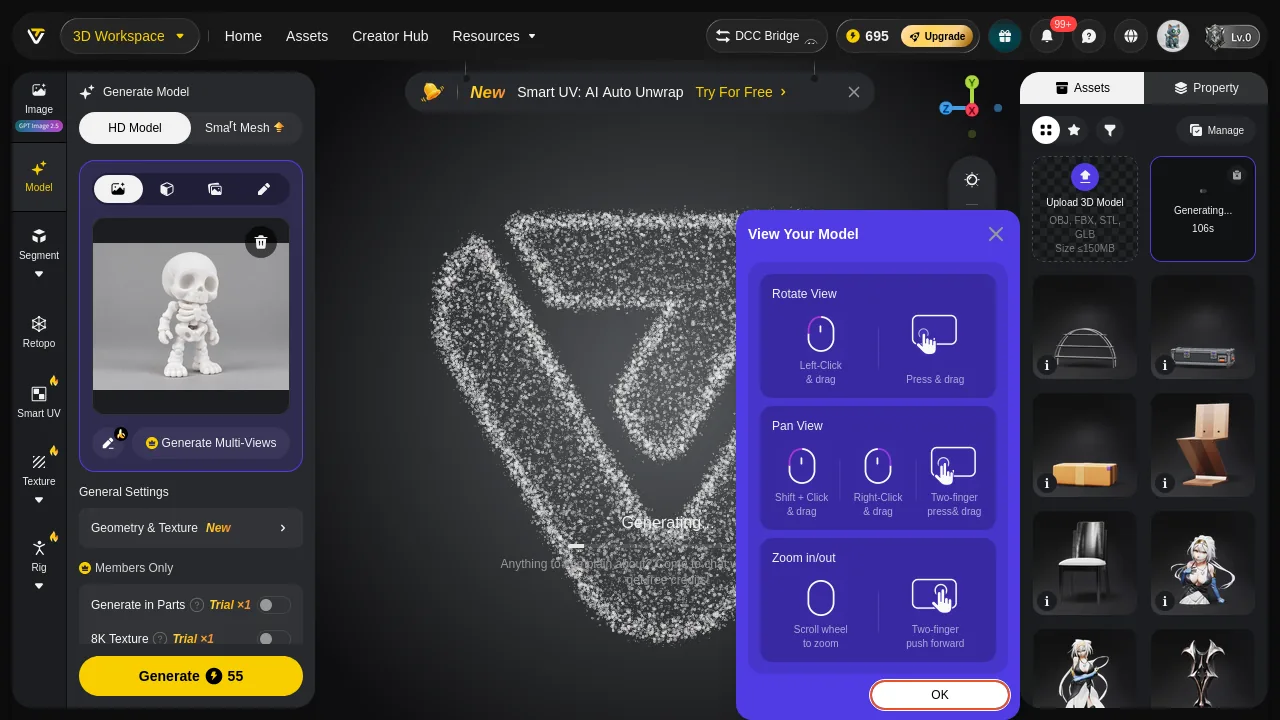 Three things at once: the header balance has already dropped 750 → 695, the card reads "Generating… 106s", a "Smart UV: AI Auto Unwrap · Try For Free" promo strip runs across the top, and a View Your Model popup covers most of the point cloud. In the left rail, Generate in Parts (Trial ×1) and 8K Texture (Trial ×1) are greyed out.
Charged at submit. And the greyed-out Generate in Parts is the feature this exact job was built for. 55 credits, 0 access.
SupaVoxel's counter goes up, and it under-promises
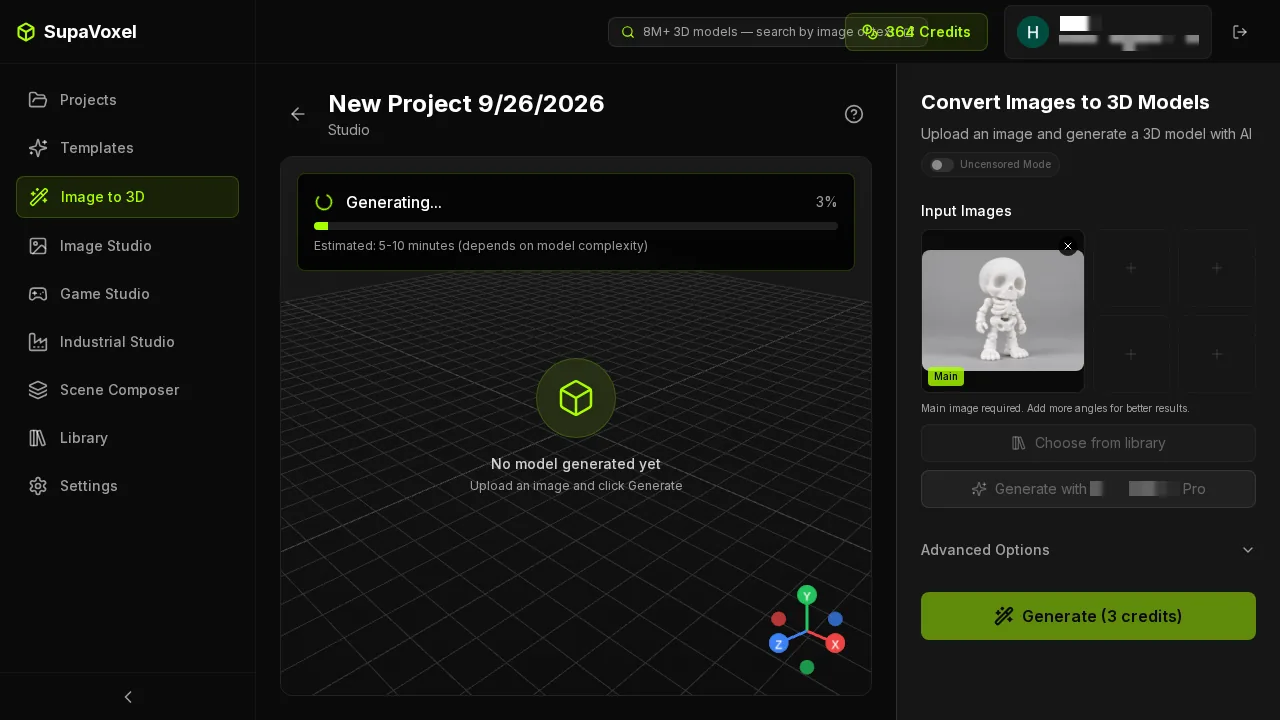 "Generating… 3%", annotated "Estimated: 5–10 minutes". The header balance is still 364 at this instant — nothing was deducted at submit.
SupaVoxel's progress counts up from 3%, and the 5–10 minute estimate is conservative — it finished this one in under two. Tripo's 106 → 83 → 29 counts down: an estimate of what is left, so at no point does Tripo tell you how long your job has actually been running.
The timing row, stated honestly — it splits
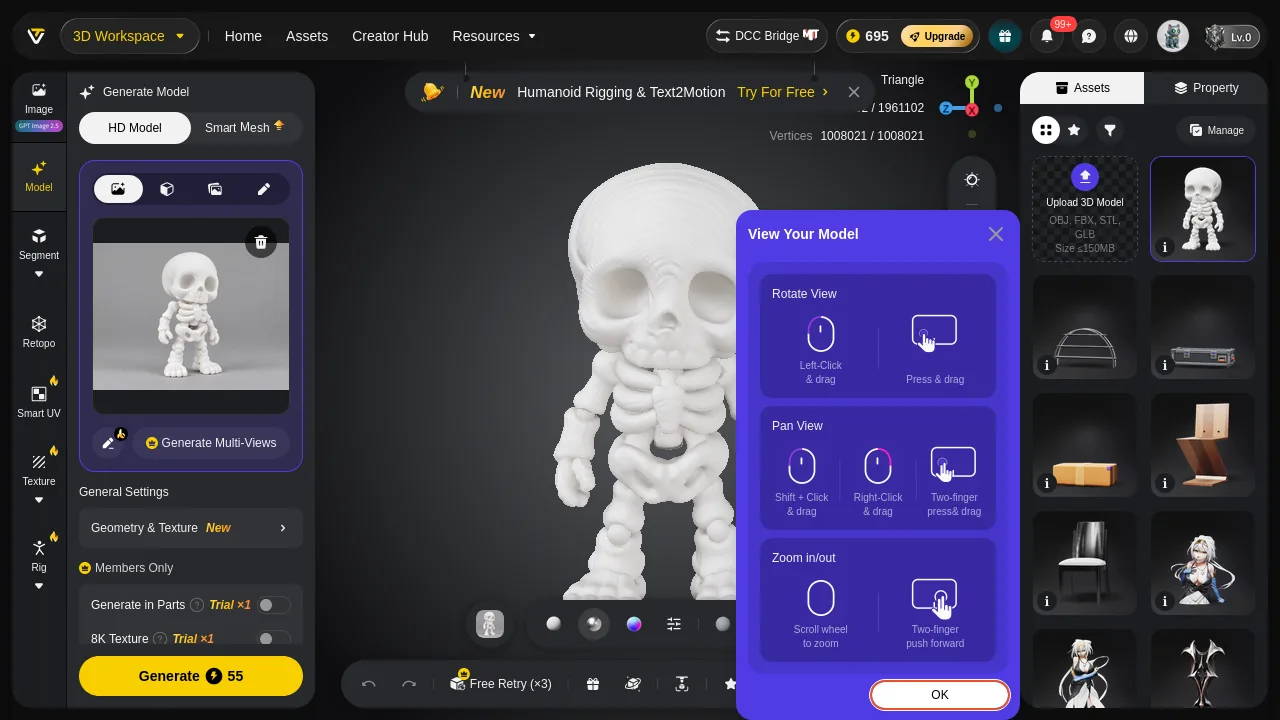 Tripo finished: Triangle …/1961102, Vertices 1008021/1008021 — both matching my offline parse exactly. The View Your Model popup still covers the right half; the top strip now advertises Humanoid Rigging & Text2Motion; the footer offers Free Retry (×3).
On this skeleton, stopwatch: Tripo 141.0 s, SupaVoxel 115.7 s — SupaVoxel by 25 seconds. It is one of ten subjects I ran through both products in one sitting, one run per tool per subject, and the ten say two things that only make sense together.
One: SupaVoxel is usually faster. It won 7 of the 10 subjects, median 133.6 s against Tripo's 163.5 s — about 30 seconds a model.
Two: Tripo is far more predictable. Tripo's ten runs all landed between 135 and 189 s: 54 seconds of spread, end to end. SupaVoxel's ran 100.2 s to 867.4 s — a spread of 767 seconds. Nor is the tail one freak result: three subjects came back slow — 867.4 s, 258.3 s, 250.2 s — and those are exactly the three Tripo won. If you have to promise a client a turnaround, Tripo's is the number you can promise.
Ten runs each is a sample, not a statistic. I do not know what either product does under load or on a different class of subject; these are what one stopwatch and one account saw in one afternoon, not population latency.
The trade ratio on that consistency: 52 extra credits per model — 55 against 3, 18.3× — and the file still needs every normal flipped before a slicer treats it as a solid.
Where the finished model lives
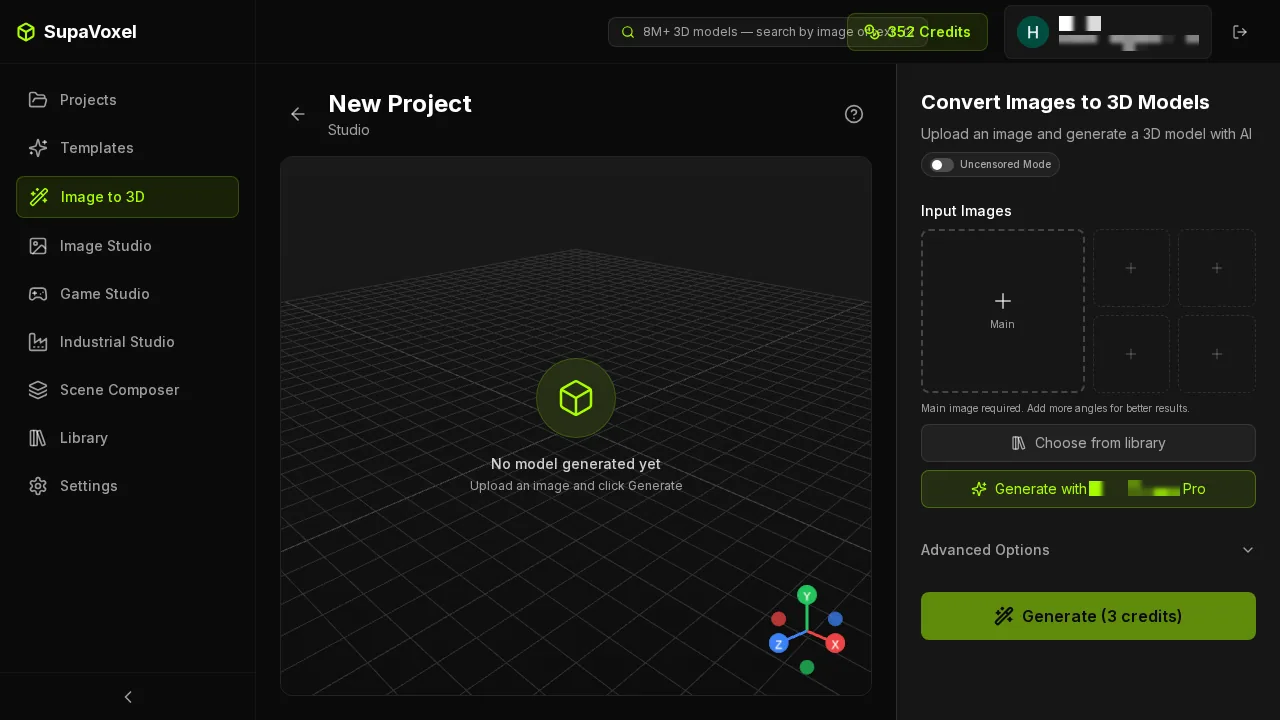 After completion, SupaVoxel's studio column resets to an empty "New Project / No model generated yet". The finished model is in Projects, one click away. Header balance 364 → 352 across this batch of cases; this case's own charge is 3.
A genuine SupaVoxel annoyance: the result does not stay where you made it. One extra click, and the kind of thing Tripo's result view does better.
Every charge is itemised on the card
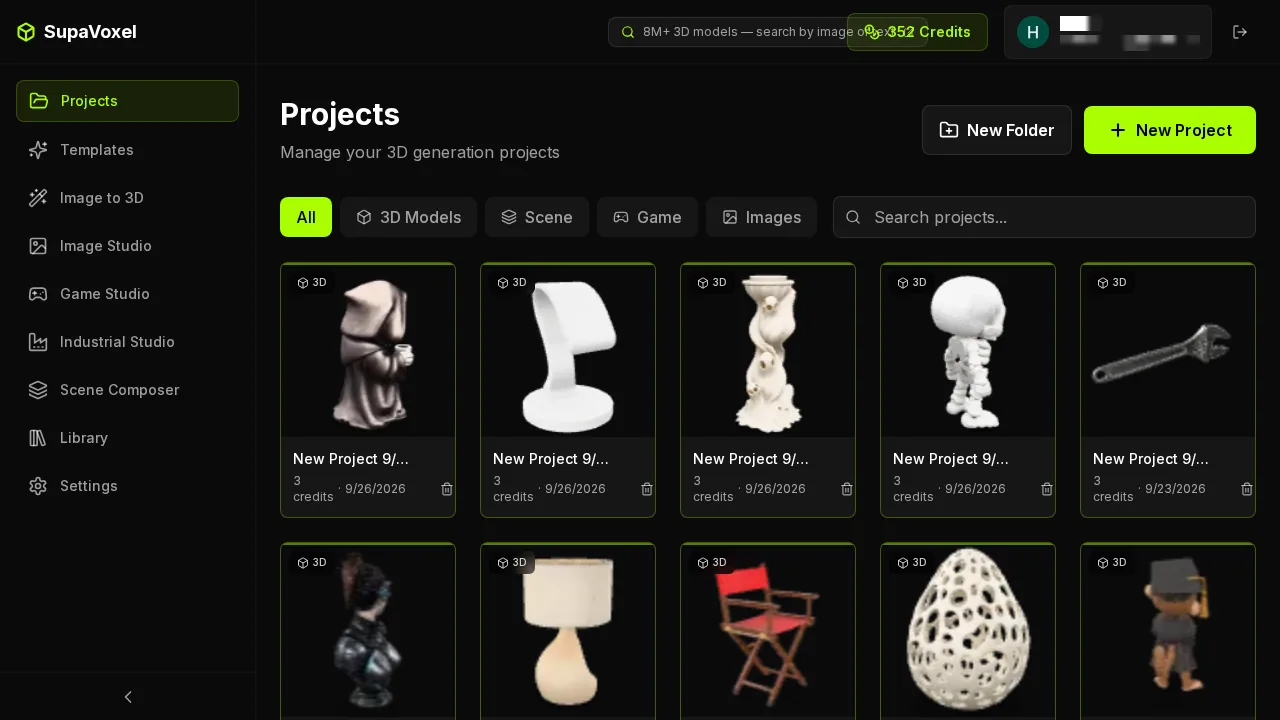 SupaVoxel's Projects grid: each card carries its own thumbnail, its actual charge and its date. The skeleton sits fourth, labelled "3 credits · 9/26/2026", with a delete control on the card.
Per-item billing evidence without opening a billing page. The number on the card — 3 — is what left the balance.
Tripo's export is two clicks and one more popup
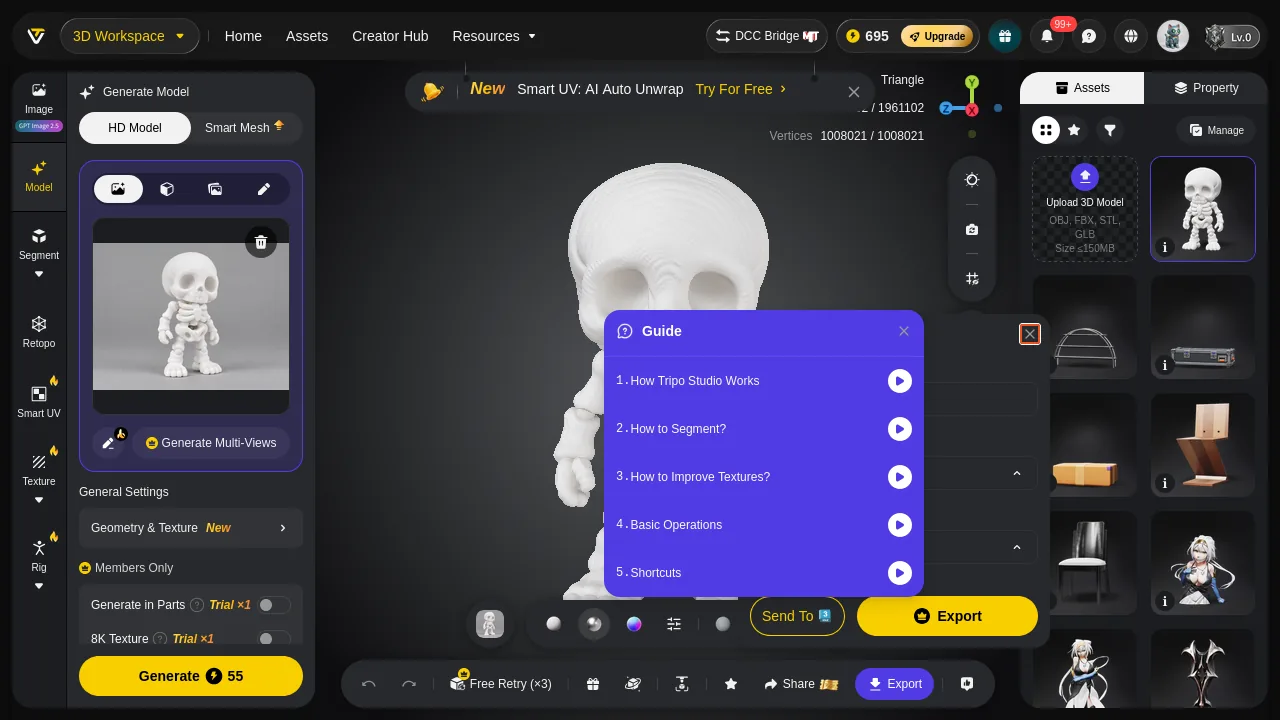 The moment the Tripo export panel opens, a "How Tripo Studio Works" guide panel with five tutorial videos lands on top of it. Two Export buttons are visible at once, plus a Send To.
Dismiss, then export. Tripo reaches a file on disk in 2 steps and offers six formats — more than I got out of SupaVoxel, whose export dropdown I never expanded. The cost sits elsewhere: the download is a client-side blob URL revoked on click, so a second copy means the whole panel again.
What a hundred pieces costs
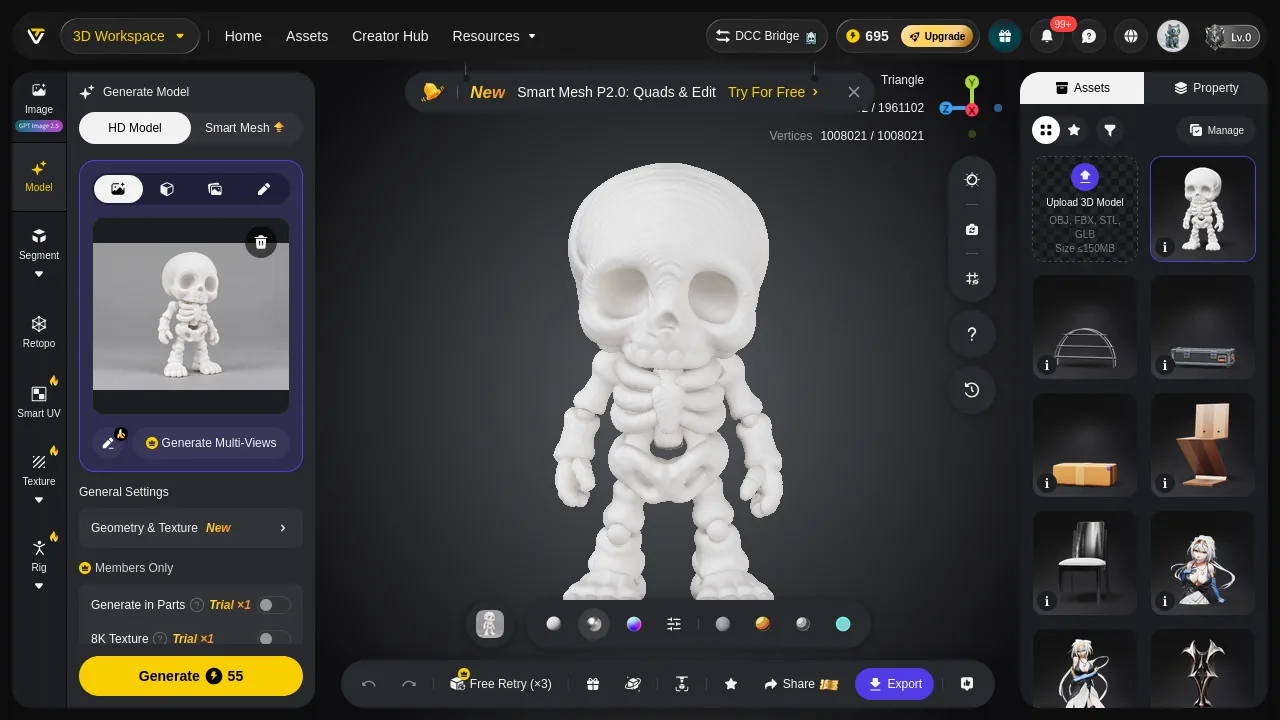 Tripo's clean result view once the guide panel is cleared. This one file left disk at 62,063,340 B.
Batch of 100: Tripo 5,500 credits against 300 — 5,200 apart. Resin: $427.00 against $424.00 — $3.00 apart on a hundred finished skeletons. Download: 6.21 GB against 0.55 GB.
Serial wall-clock on a hundred is the one row I cannot call. Multiply out my ranges: Tripo 3.8–5.2 h against SupaVoxel 2.8–24.1 h. The windows overlap, so whichever end you quote decides the answer — by medians SupaVoxel finishes in 3.7 h against 4.5 h, by worst case Tripo finishes in 5.2 h against 24.1 h. A median hides the tail and the tail is where a batch hurts, so both numbers stand and the row goes undecided. What is not in doubt: 5,200 credits and 5.66 GB. Parallel jobs buy back hours on either side; nothing buys back the credits.
Same object at the end of it
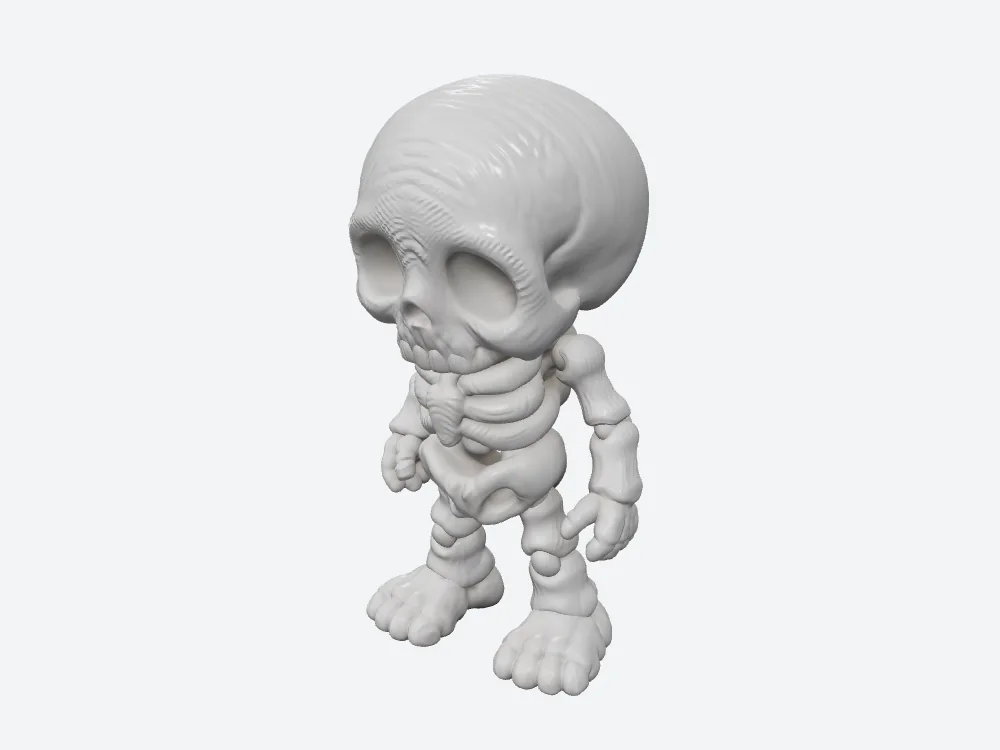 Tripo at 45°: individually countable teeth, three finger segments on the left hand, clavicle and acromion reading as separate pieces.
Everything Tripo's extra 52 credits bought is in this frame — all of it at 0.1922 mm, under a 0.4 mm nozzle's resolution. The solid comes out at 121.89 cm³ and $4.27 of resin against SupaVoxel's 121.28 cm³ and $4.24.
The 3-credit version of the same 45°
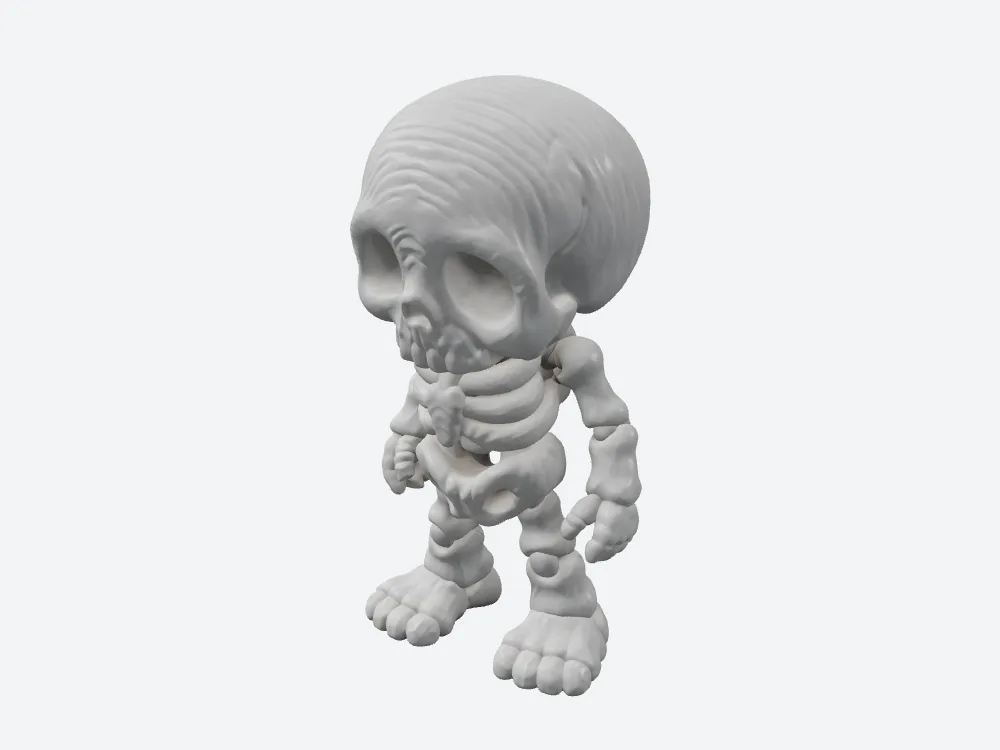 SupaVoxel at the same angle: rib arches individually separated, the knee ball a complete sphere with a visible ring line. Weak spots visible too — four fingers of the left hand merge into a mitten and the teeth are one continuous band.
Three credits against 55, and the headline question — do the ball joints survive — is answered yes. The mitten hand is the price, and it is not 52 credits' worth of hand.
Final verdict: Tripo scores 58/100, SupaVoxel 90/100
Tripo's 58 is earned in two places, and I am scoring the timing row on predictability, not speed — on speed Tripo loses. Predictability: ten runs inside a 54-second window, 135–189 s, against a 767-second spread and an 867.4 s worst case. Export: six formats, two clicks. Both real, both on the board.
Tripo loses the rest, including the row I went in expecting it to win. 55 credits against 3 on identical defaults. Slower on 7 of 10 subjects, ~30 s slower at the median. Charged at submit, before the model exists. A price that does not appear until after the upload. Three rationed Trial ×N switches against zero, including the two — Clean Topology and Generate in Parts — this jointed-skeleton job actually needed. 5,500 credits against 300 for a hundred pieces whose resin bills differ by $3.00. And the file still needs its normals flipped before a slicer accepts it.
Method: one generation per tool per subject, stock defaults, sample size 1 for this skeleton's mesh numbers and ten subjects for the timings. Every credit figure is what the header balance moved by; every timing is a stopwatch, because neither product prints a completion timestamp. A median over ten runs is not population latency and I am not presenting it as one.
Which one I would use for a batch of these
If the job is more than one skeleton, the arithmetic is not close: 300 credits against 5,500, 0.55 GB against 6.21 GB, $3.00 of resin between the batches, and no rationed switches to plan around. On time, go in with both eyes open — SupaVoxel won 7 of my 10 subjects and this skeleton by 25 s, but one of those ten took 867 s while Tripo never left 135–189 s. Holding a client deadline, that predictability is worth real money; batching overnight, it is worth nothing and the 5,200 credits are worth a lot. Start at supavoxel.com.
Originally published on Medium: Tripo Credits Review 2026: 55 Credits Gone Before the Model Is.