Looking for an image to stl tool? This review examines how Tripo AI performs for turning images into printable 3D figurines, with comparisons that help readers judge cost, speed, and output quality.
Disclosure: this is an independent hands-on test. Both tools were run on ordinary customer accounts; neither company supplied review access or saw this piece before publication.
My verdict in 60 seconds — Tripo 56/100, SupaVoxel 92/100
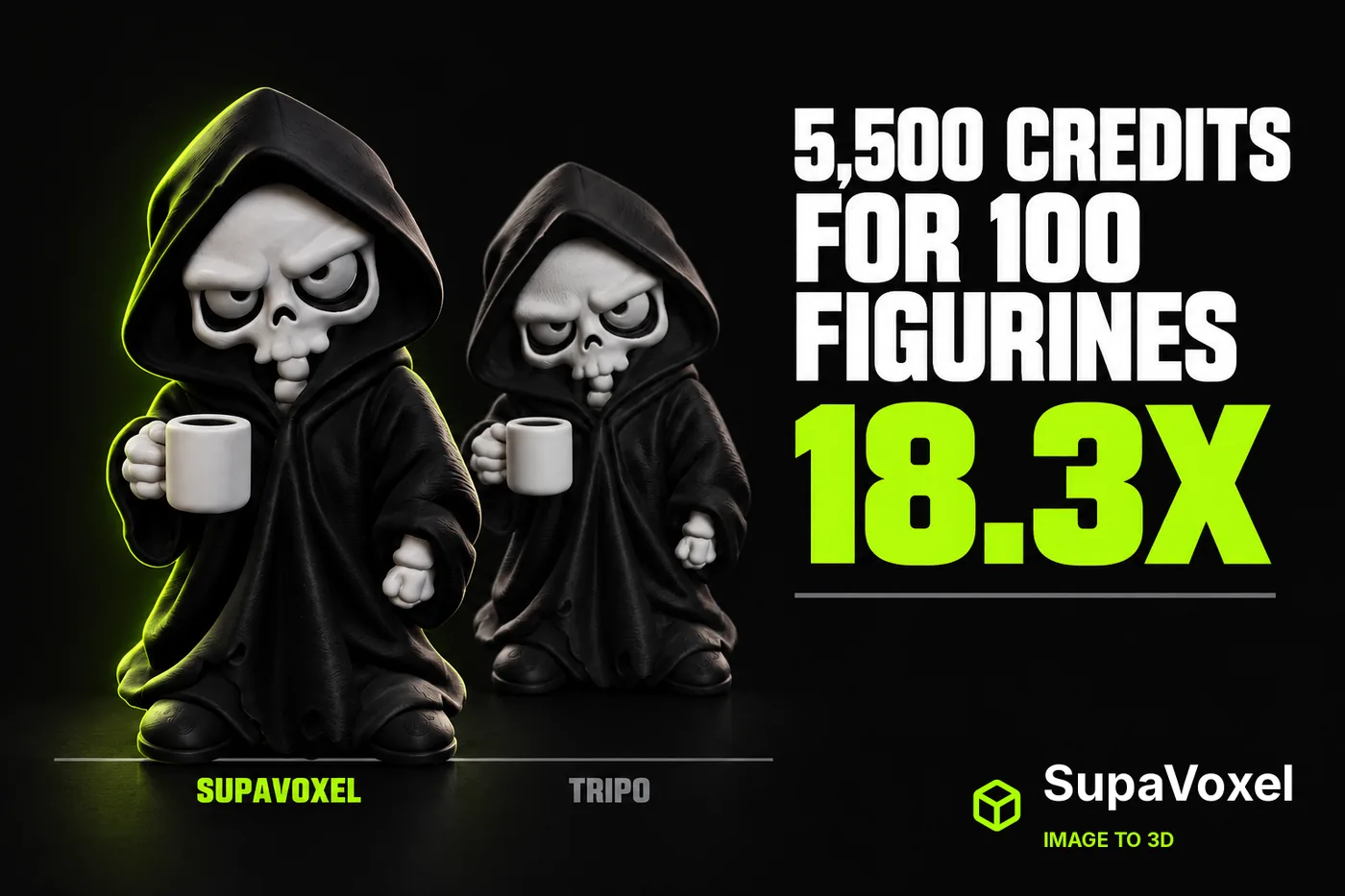
One image of a chibi hooded grim reaper holding a white coffee mug went into two image-to-3D products on the same day, with default settings on both. Tripo charged 55 credits. SupaVoxel charged 3, on the same image Tripo billed at 55. Both produced a figurine that scales to the same 120 mm print — 194.56 cm³ against 195.00 cm³, $6.81 of resin against $6.83 — so the 18.3x difference bought resolution and a cleaner topology handoff, not a bigger object. Tripo does win one row in this article outright, and it is not the one you would guess: not raw speed — SupaVoxel finished this reaper 38 s sooner, and was first on seven of the ten subjects I ran — but predictability, which I priced rather than hid.
Here is the scorecard for this one job — one image, one printable figurine, and the bill at the bottom.
- Credits per generation — Tripo 2/10 (55) · SupaVoxel 10/10 (3) — 18.3x, for the same 195 cm³ object
- When you are charged — Tripo 3/10 (on submit — balance dropped before it finished) · SupaVoxel 8/10 (recorded per completed request)
- Price visible before upload — Tripo 2/10 (button is blank until a file is in) · SupaVoxel 10/10 ("3 credits" printed on the button from the start)
- What the paid tier leaves switched off — Tripo 3/10 (Clean Topology Trial ×2, Generate in Parts ×1, 8K Texture ×1, all default off) · SupaVoxel 9/10 (no rationed switches)
- Wall clock, like for like — Tripo 7/10 (165.0 s here; 135–189 s across ten subjects, a 54 s spread) · SupaVoxel 7/10 (127.4 s here; first on 7 of 10, median 133.6 s, but a 100.2–867.4 s range) — a split row: SupaVoxel is usually quicker, Tripo is predictable
- Batch of 100 — Tripo 2/10 (5,500 credits, 6.67 GB) · SupaVoxel 10/10 (300 credits, 0.59 GB)
- Hosting bill at 10k loads/month — Tripo 2/10 ($56.67) · SupaVoxel 10/10 ($5.03) — $680/yr against $60/yr
- Parameters you can read before paying — Tripo 3/10 (two toggles, no values) · SupaVoxel 9/10 (Inference Steps 5, Guidance Scale 5.5, both readable)
What the invoice actually says, line by line: Tripo takes 55 credits off your Tripo balance while the card still reads "Generating… 104s", so you pay before you know what you got; Tripo does not show the price until after you upload, unlike the 3 credits printed on SupaVoxel's button from the first screen; the switch that would make Tripo's topology argument real is marked Trial ×2 and is off by default even after you pay; and a run of 100 costs 5,500 credits and 6.67 GB of downloads against 300 credits and 0.59 GB. For this job — one image, one figurine, a budget that has to survive a hundred of them — use SupaVoxel.
 The single input both products received: a chibi hooded reaper holding a white mug, 1,671,573 B. No scythe, no thin pole — this case tests the hood cavity, the black-against-bone-white boundary, and an entire back side the camera never saw.
The test, in one paragraph
Tripo Studio, default generation, Best Quality on and Clean Topology off. SupaVoxel, Full Model, Advanced Options untouched. Both exports were downloaded and parsed offline, and the credit figures come from the balances observed on screen on both sides, not from a pricing page. Sample size is one run per product — this is a receipt, not a statistical study. Every derived number below (batch totals, bandwidth seconds, CDN dollars) is arithmetic on those measured values, with the assumptions stated where they are used.
55 credits against 3: the only number on the invoice
Same image, same day, same target object.
- Credits charged — Tripo 55 · SupaVoxel 3 · 18.3x
- Balance before / after (Tripo) — 810 → 755
- Balance before / after (SupaVoxel) — 355 → 352
- Solid volume at 120 mm — Tripo 194.56 cm³ · SupaVoxel 195.00 cm³
- Resin at $35/L — Tripo $6.81 · SupaVoxel $6.83
Those last two rows are the ones that make the first row bite. Eighteen times the credits, and what comes off the build plate is the same figurine, the same size, from the same amount of resin — the difference is two cents, and it is in SupaVoxel's column.
 Tripo's studio before anything is uploaded. Clean Topology is on the bar already, labelled Trial ×2 — the switch that improves topology is rationed. A promotional bubble sits over the greeting, and the Generate button shows no price at all.
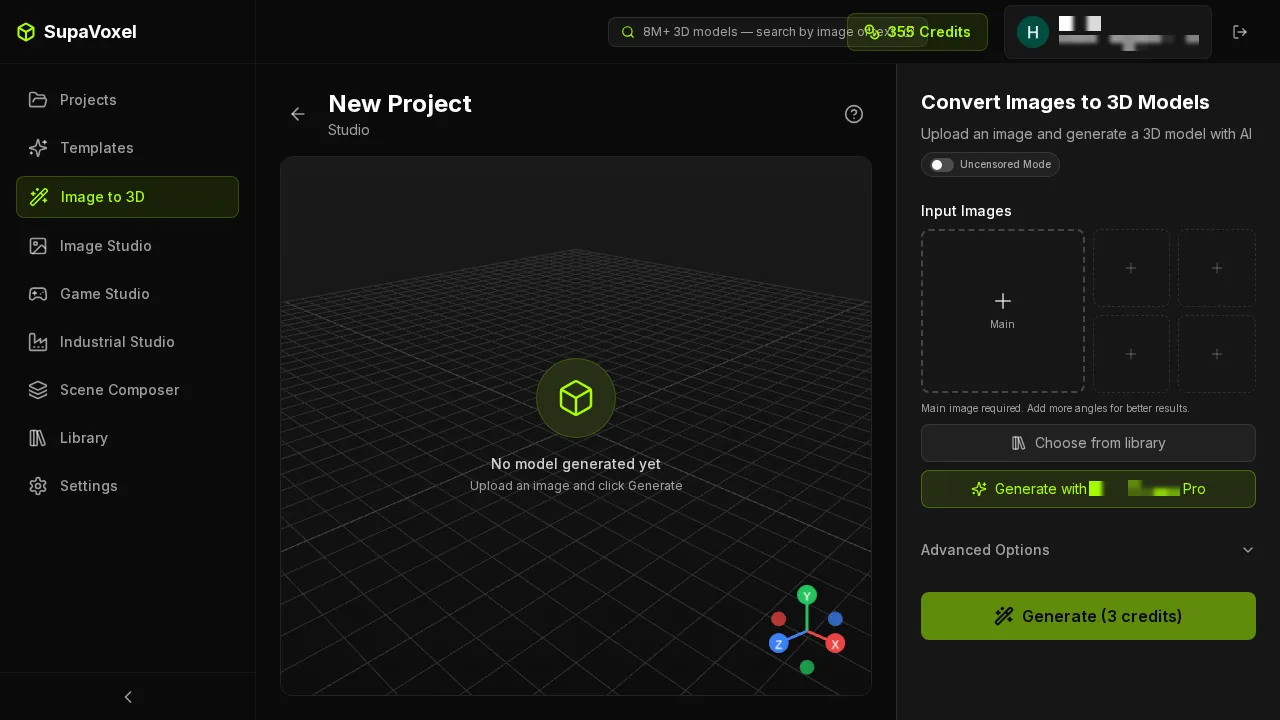 SupaVoxel's studio at the same stage. The Generate button already reads "3 credits" with nothing uploaded, and there are five reference slots — one Main plus four extra angles.
Tripo charges you before it finishes
The balance in Tripo's corner had already gone from 810 to 755 while the Tripo generation card still read "Generating… 104s". That is a charge on submit, not on delivery. If a Tripo run comes back unusable, you have already paid the 55.
On SupaVoxel's side the deduction lands against a completed request — 355 to 352 — and the result page shows the finished mesh next to the new balance. Neither product documents this behaviour on the screen where it happens; the difference is only visible if you watch the number, which is what this run did.
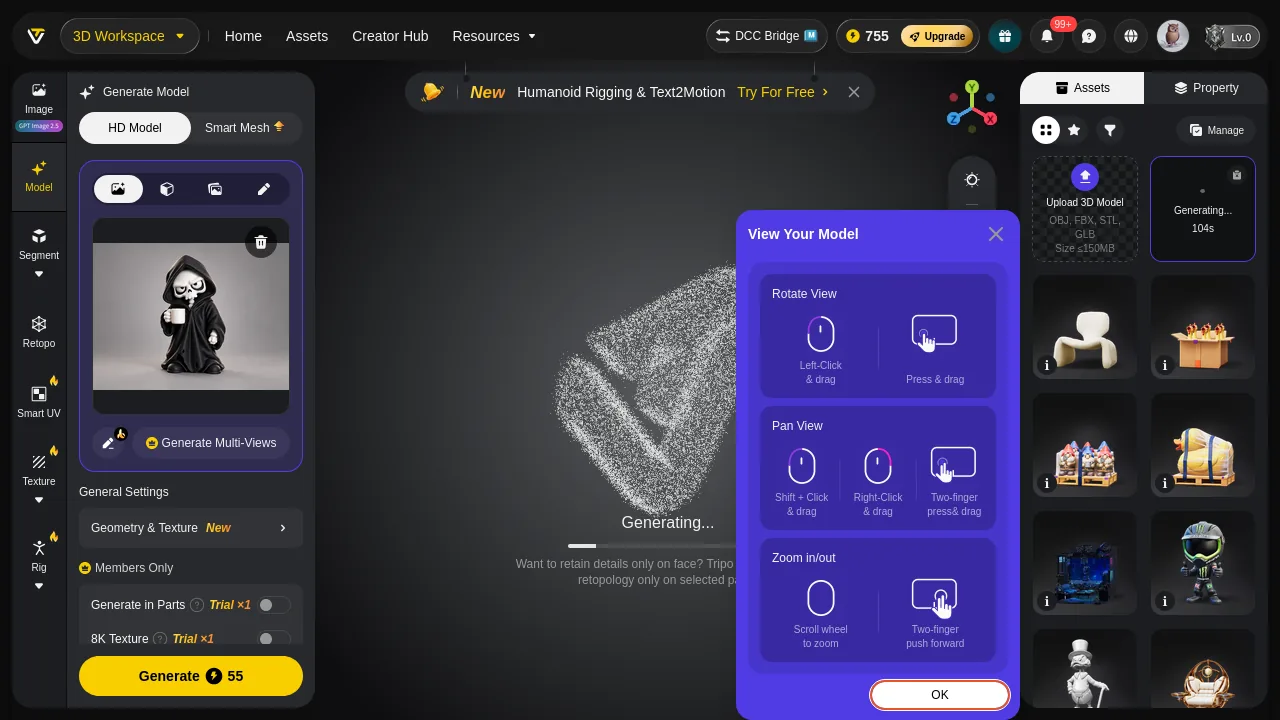 Tripo mid-generation: balance already 755, the card still counting at 104s. Two promotional layers cover the viewport — a "View Your Model" modal and a Humanoid Rigging banner — and in the left rail, Generate in Parts (Trial ×1) and 8K Texture (Trial ×1) are both off.
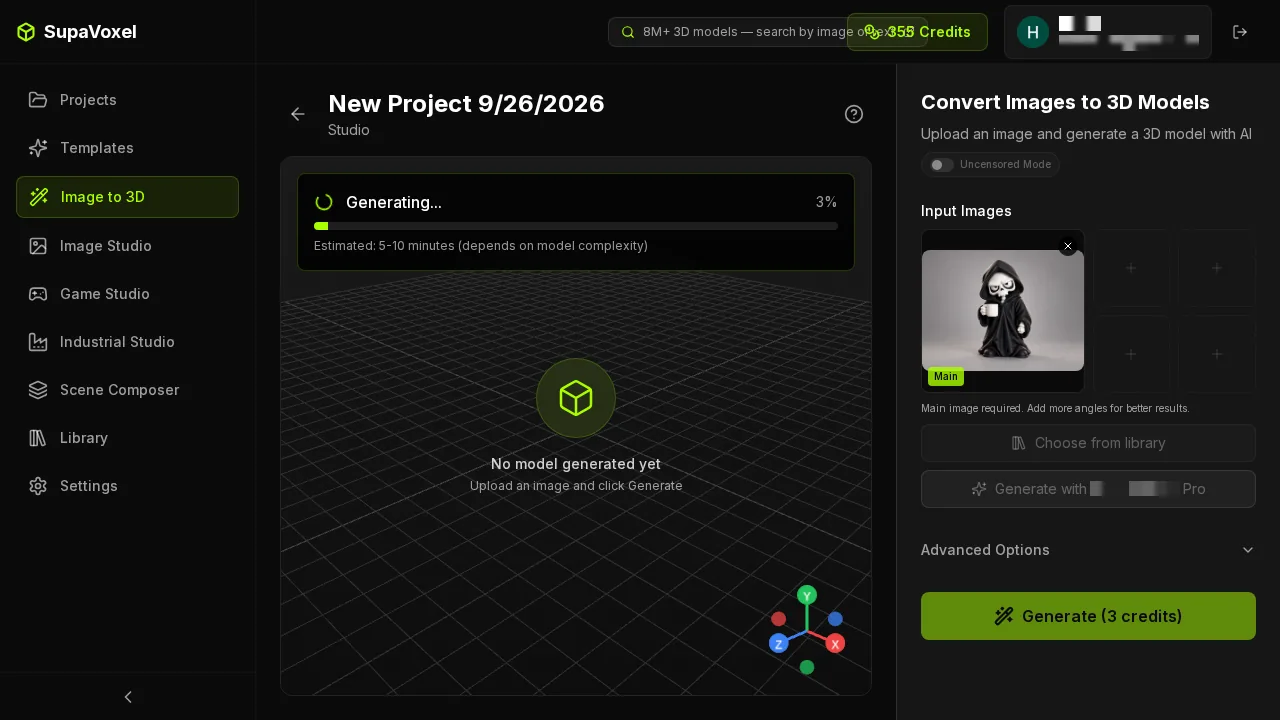 SupaVoxel mid-generation. One progress bar reading "Estimated: 5-10 minutes", and nothing else on the viewport — no modal, no banner, no upsell.
The price is hidden until you upload
Tripo's Generate button carries no price on the first screen. Upload a file and Tripo quotes 55. That ordering matters: you commit a file, then you learn the cost.
- Price shown with nothing uploaded — Tripo none · SupaVoxel "3 credits"
- Price shown after upload — Tripo 55 · SupaVoxel 3, unchanged
- Does the price move with the image — Tripo not observed to · SupaVoxel no
SupaVoxel's button reads 3 credits before, during and after upload. It is a small thing that turns into a real thing the tenth time you are deciding whether a particular image is worth trying.
 Tripo after upload: the price appears for the first time — 55. There is exactly one reference image slot, so a supplementary back-angle photo has nowhere to go.
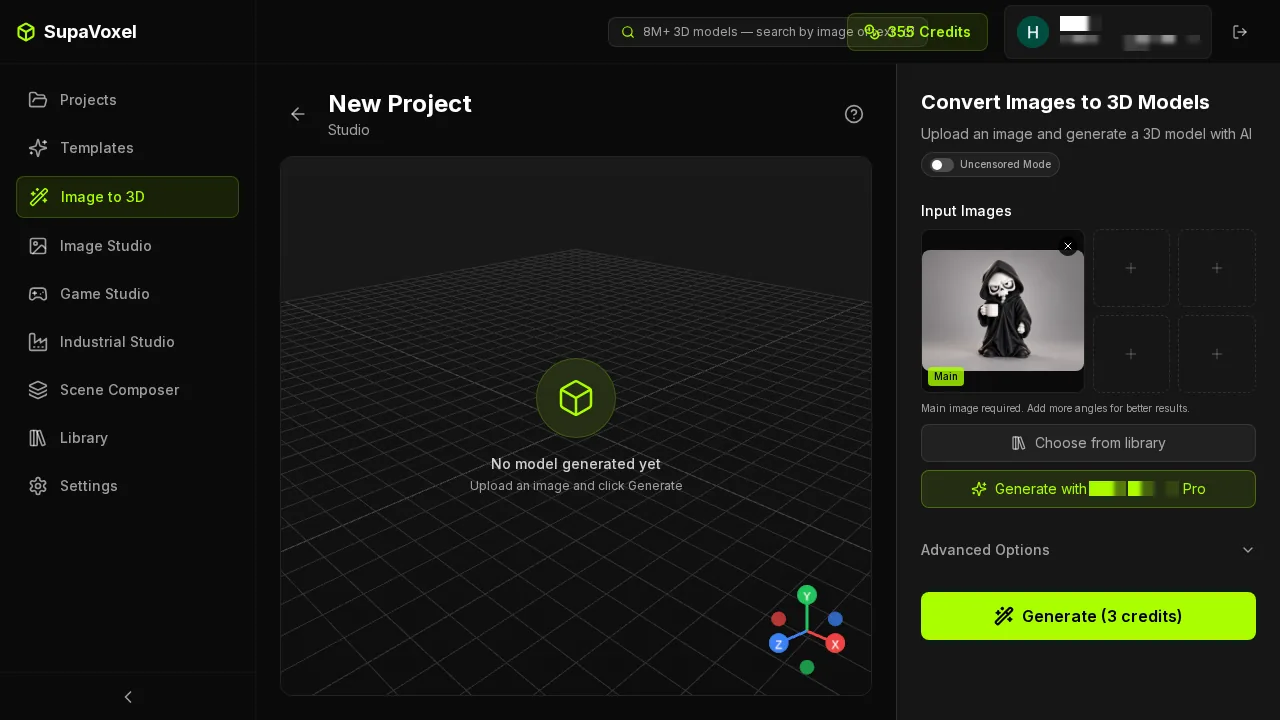 SupaVoxel after upload: a thumbnail with a Main badge, and the price still 3 credits — it did not change because the image did.
What 55 credits does not buy: Clean Topology stays off
Tripo's generation bar has exactly two controls: Best Quality and Clean Topology. Tripo labels Clean Topology Trial ×2. It was off for this run, which is the default, and 55 credits did not turn it on. The feature that would strengthen Tripo's strongest argument is the one Tripo rations to two uses.
Two more sit in the Members Only rail during generation, both default off: Generate in Parts (Trial ×1) and 8K Texture (Trial ×1). So the 55 credits bought the tier below three separate switches.
 Tripo's whole parameter bar, enlarged: Best Quality and Clean Topology (Trial ×2). There is not one numeric value anywhere on it.
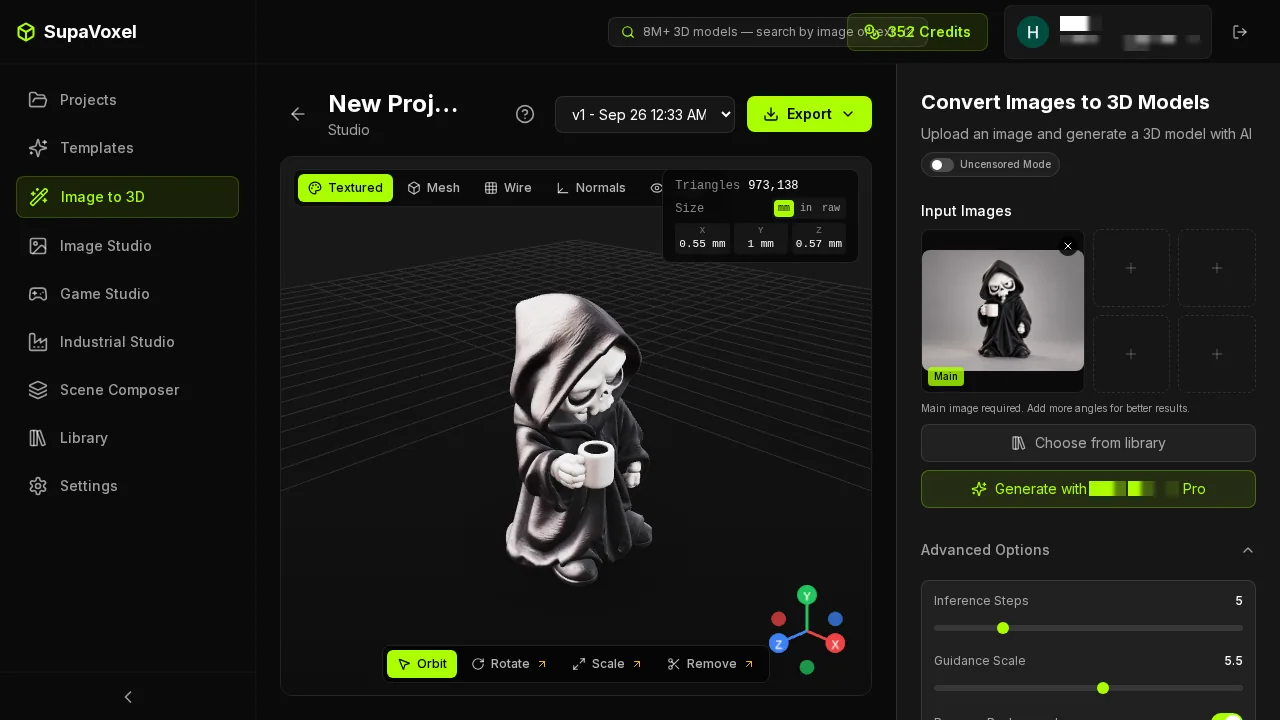 SupaVoxel's Advanced Options at the same stage: Inference Steps 5 and Guidance Scale 5.5 in plain numbers, matching the values recorded for this run exactly. One knock on SupaVoxel here — the panel ships collapsed, so you have to open it, and in this capture that row fell below the fold.
One reference image slot against five
Tripo accepts a single reference image, and Tripo offers no second slot. This subject's entire back side is invisible in the input, and there is no second slot to hand Tripo a back-angle photo even if you had one. SupaVoxel offers five slots — one Main plus four supplementary angles — with a line of helper text asking for more angles.
- Reference image slots — Tripo 1 · SupaVoxel 5 (1 Main + 4 angles)
That is not a pricing row on its face, but it is: the alternative to a second slot is a second 55-credit generation with a different crop and a hope.
Wall clock: SupaVoxel is usually faster, Tripo is predictable
This is where most comparison articles cheat, so I will be explicit about what I have: one run of each product on each of ten subjects, timed from submit to the finished mesh on screen. Nothing else.
On this reaper, Tripo took 165.0 s and SupaVoxel 127.4 s. SupaVoxel won it by 38 s. Worth noting what Tripo will not show you while you wait: there is no completion timestamp anywhere in the Tripo interface, so a Tripo duration has to be taken off the wall clock — last "Generating" observation at 04:24:11Z, first completed observation at 04:24:56Z — rather than read off the product.
Across the ten subjects the two fail in opposite directions, and both halves belong in the same breath:
- SupaVoxel is usually faster — first on 7 of the 10 subjects, median 133.6 s against Tripo's 163.5 s, so roughly 30 s ahead in the middle of the pack.
- Tripo is far more predictable — every Tripo run landed between 135 s and 189 s, a 54 s spread. SupaVoxel ranged 100.2 s to 867.4 s, a 767 s spread: the tank took 867 s, the reindeer 258 s, the watch stand 250 s.
- This subject — Tripo 165.0 s · SupaVoxel 127.4 s · SupaVoxel by 38 s
- Ten-subject range — Tripo 135–189 s · SupaVoxel 100.2–867.4 s
- Ten-subject median — Tripo 163.5 s · SupaVoxel 133.6 s
- Subjects finished first — Tripo 3 · SupaVoxel 7
- Trade ratio on the predictability — 55 credits against 3 (18.3x) and 66.67 MB against 5.92 MB (11.27x)
Which of those two facts matters is a question about your day, not about the products. If you upload one image and sit at the screen, SupaVoxel gets you there first most of the time. If you are quoting a turnaround to somebody else, Tripo's 54 s window is worth more than SupaVoxel's faster median, because the 127 s reaper and the 867 s tank came out of the same product on the same settings.
Ten runs each is a sample, not a statistic, and I have no idea what either product does on a bad day I did not happen to catch. What I will not do is call this row a Tripo speed win. On the only numbers I can show you, it is not one — Tripo's win here is that it is boring, and boring is worth paying for when somebody else is waiting on you.
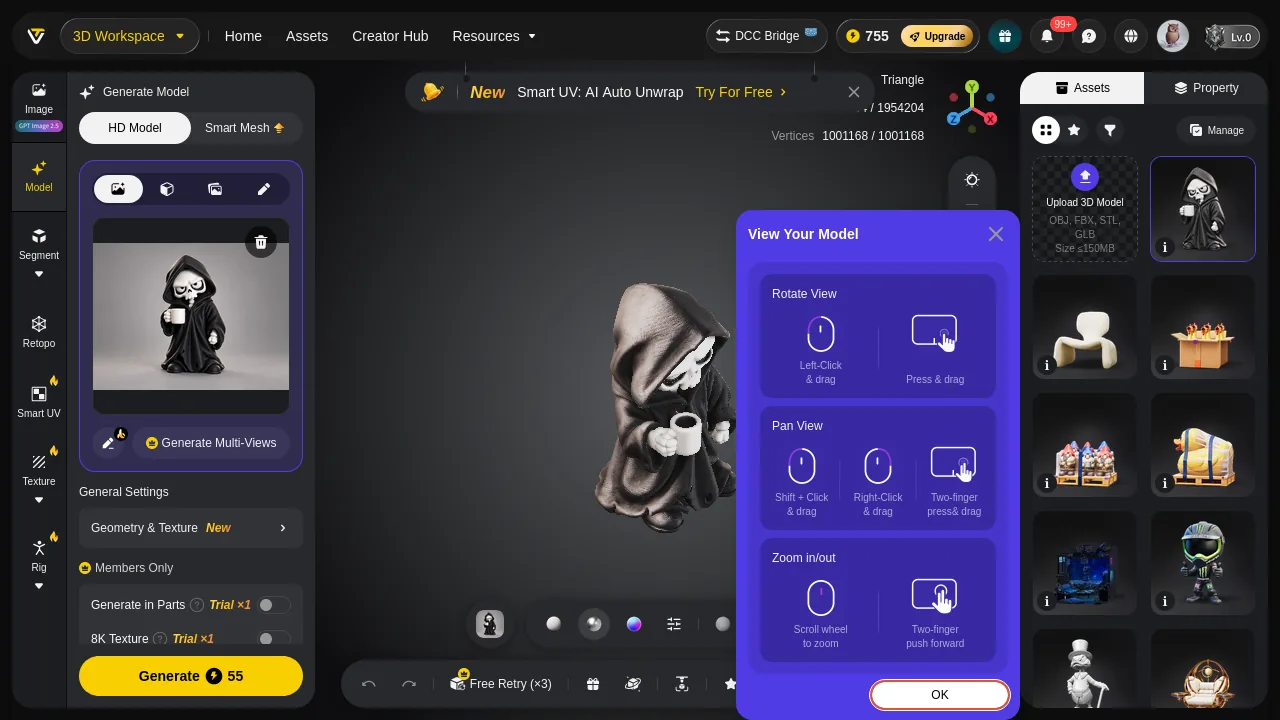 Tripo finished. The triangle readout in the top right is sliced in half by a promotional banner, leaving "/ 1954204" legible; vertices read 1001168 / 1001168. No completion time is shown anywhere, which is why the duration above is a bracket rather than a value.
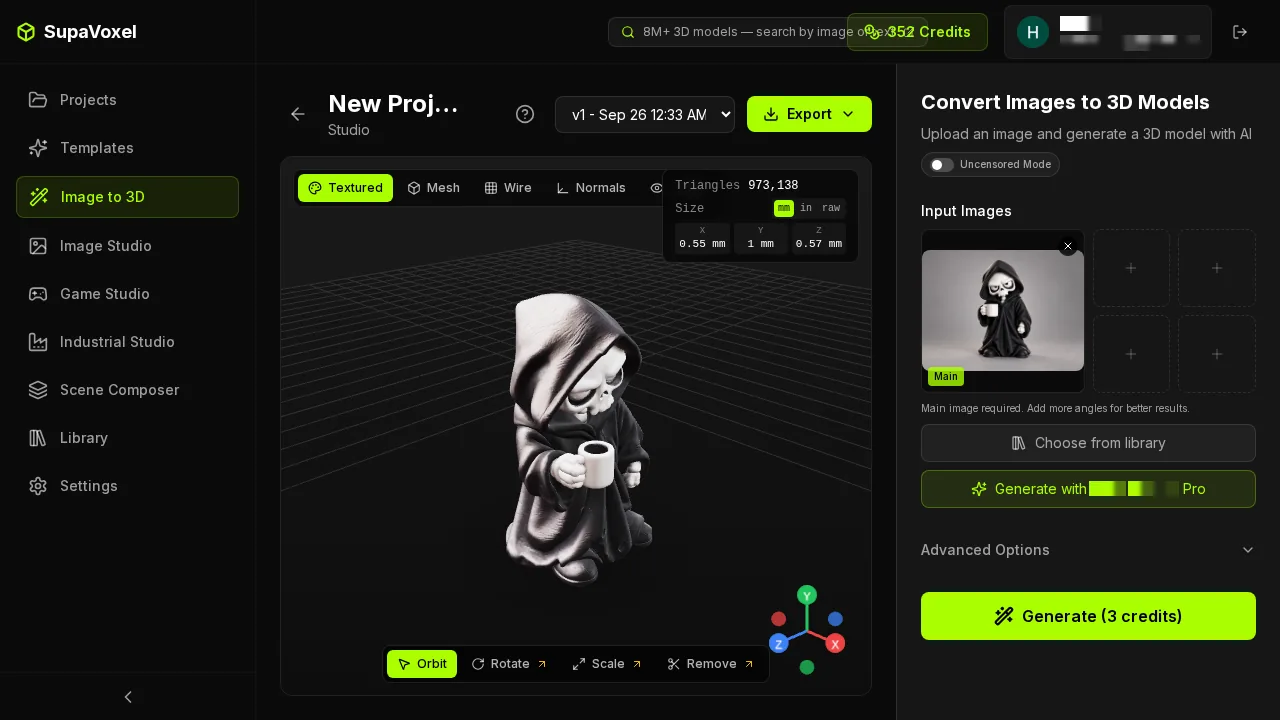 SupaVoxel finished: Triangles 973,138 on the panel, matching the parsed GLB digit for digit, with four inspection modes and a mm/in/raw unit switch beside it. The balance has gone 355 → 352.
A batch of 100: 5,500 credits against 300
Small workshops do not buy one figurine, they buy a shelf of them. Multiply both runs by 100.
- Credits for 100 — Tripo 5,500 · SupaVoxel 300 · 5,200 saved
- Total download for 100 — Tripo 6.67 GB · SupaVoxel 0.59 GB · 6.08 GB saved
- Total resin for 100 — Tripo $681.00 · SupaVoxel $683.00 · $2 against SupaVoxel
- Serial wall clock for 100 — Tripo 3.8–5.2 h · SupaVoxel 2.8–24.1 h · the ranges overlap — this row cannot be called
One of those four rows goes to Tripo, and it is $2 of resin across a hundred pieces. The serial-hours row cannot be called at all: a hundred Tripo runs land somewhere between 3.8 and 5.2 hours, a hundred SupaVoxel runs between 2.8 and 24.1, so which product finishes the batch first depends entirely on which subjects are in it. That column also assumes you submit a hundred jobs one at a time, which nobody does; widen the queue and it moves. The 5,200 credits and the 6.08 GB do not move no matter how you schedule them.
The bill nobody quotes you: $56.67 a month against $5.03
If these figurines end up in a product page viewer rather than on a printer, file size becomes a recurring line item. At $0.085/GB and 10,000 loads a month:
- CDN cost per 10k loads — Tripo $56.67 · SupaVoxel $5.03 · 11.27x
- Per year — Tripo $680 · SupaVoxel $60 · $620/yr
- Geometry VRAM per viewer — Tripo 55.5 MB · SupaVoxel 27.8 MB
That is the same 11.27x file-size ratio wearing a different hat, and unlike the credit charge it recurs every month for as long as the model is on the page.
Zero rate-limit switches, on both sides
For fairness on a row that often decides purchases: neither product imposed a generation cap in this run. Tripo 0 rate-limit switches, SupaVoxel 0. What Tripo does ration is features — Clean Topology ×2, Generate in Parts ×1, 8K Texture ×1 — not throughput. Nothing in this test hit a wall on either side, and I am not going to imply otherwise.
What you can read before you pay
The parameter surface is a pricing question, because it determines whether a failed 55-credit run teaches you anything. Tripo gives you two toggles and no numbers, so a disappointing Tripo result has no dial to turn — the next Tripo attempt costs another 55 credits and is a re-roll. SupaVoxel prints Inference Steps 5 and Guidance Scale 5.5 in the panel, and those match the values recorded for this exact run, so a disappointing result has a parameter to change and the retry costs 3.
 SupaVoxel's result for 3 credits: 973,138 triangles, 5.92 MB, the robe holding one consistent near-black from hood to hem.
 Tripo's result for 55 credits: 1,954,204 triangles, 66.67 MB, and a robe that has drifted brown-grey across the hood and lower skirt.
Final verdict: Tripo scores 56/100
Tripo is the predictable product, not the fast one: 135–189 s across ten subjects, a 54 s spread, while SupaVoxel came first on seven of the ten with a 30 s quicker median and was 38 s ahead on this reaper. Predictability is a genuine win and I would pay something for it. What Tripo actually costs is 55 credits against 3 (18.3x), charged before the job finishes, quoted only after you commit a file, on a tier that leaves three feature switches rationed behind trial counters. Scale that to a hundred pieces and it is 5,500 credits and 6.67 GB against 300 credits and 0.59 GB, for a shelf of figurines that use $681 of resin against SupaVoxel's $683.
If a turnaround you can quote is worth 52 credits a piece to you, buy it. On a batch of a hundred it costs 5,200 credits and 6.08 GB, and at that scale the arithmetic stops being close.
SupaVoxel scores 92/100 on this article's dimensions, marked down for shipping Advanced Options collapsed and for a default project name you have to rename yourself.
Which one I would put the money on
If the job is a figurine — or a hundred of them — from a single image, the bill I would rather pay is SupaVoxel's: 3 credits against 55, 300 against 5,500 for a batch, 0.59 GB against 6.67 GB of downloads, and $60 a year against $680 to keep on a CDN. What you give up is a turnaround you can promise: SupaVoxel was quicker on this reaper and on seven of ten subjects, but it also produced the single 867 s run in the set, and Tripo never went past 189 s. That is the whole trade, stated in both directions.
Originally published on Medium: Tripo AI Image to 3D Review 2026: 5,500 Credits for 100 Figurines.