Readers comparing image to stl options will find a step-by-step pricing breakdown of Meshy 3D Agent against Snapshapy, including credits for concept, rigging, motion and print-file repair.
One female explorer for a 3D platformer, taken from concept to a rigged run-and-jump model and a 15 cm print file, cost me 61 credits on Meshy 3D Agent and 14 on Snapshapy's 3D Agent: 4.4× the credits, $1.22 against $0.67. The telling line on the bill is not the 30-credit 3D step. It is a 12-credit charge to cut a character out of a concept sheet Meshy drew itself, plus a 10-credit print repair that cost more than Snapshapy's rig, motions and print file put together.
I ran both agents from my own paid accounts, Meshy Pro at meshy.ai and Snapshapy Pro at snapshapy.com, and typed the same four messages into each on 2026-11-03: four concept options, a textured 3D model of option 1, a rig with run and jump, and a file to print at about 15 cm. On every choice card I took the first option. I ran the print step on Snapshapy again the next day, after an update; the Meshy numbers are from the first day.
Prices first. Meshy Pro is $20 a month for 1,000 credits, $0.02 a credit. Snapshapy Starter is $19 for 400 credits and Pro is $29 for 600, about $0.048 a credit on either. The cheaper credit is Meshy's, by more than half. The bill is decided by how many credits each step eats.
My verdict in 60 seconds — Meshy 3D Agent 60/100, Snapshapy 90/100
Meshy prints a fair price on its cards, but it bills four paid steps for one explorer, one of them only to clean up its own concept, and lands at 4.4× Snapshapy's total.
- Credits for the whole explorer — Meshy 5/10 · Snapshapy 9/10 — 61 vs 14 credits, 4.4×
- Price per finished character — Meshy 6/10 · Snapshapy 9/10 — $1.22 vs $0.67 on Starter and $0.68 on Pro
- Concept step — Meshy 4/10 · Snapshapy 9/10 — 21 credits for 1 character sheet plus its cut-out vs 8 for 4 separate explorers
- 3D model step — Meshy 5/10 · Snapshapy 9/10 — 30 vs 3 credits, $0.60 vs $0.14, 10×
- Rig and motions — Meshy 7/10 · Snapshapy 9/10 — one refusal at 1.86 million faces and 4 rig-flow clicks vs one automatic 3-credit step
- Print repair cost — Meshy 6/10 · Snapshapy 9/10 — 10 credits ($0.20) vs 0
- Print file — Meshy 8/10 · Snapshapy 9/10 — both watertight, one body, 150.0 mm tall; 50.0 MB vs 7.5 MB
- Characters per ~$20 month — Meshy 5/10 · Snapshapy 9/10 — 16 on Pro ($20) vs 28 on Starter ($19), 42 on Pro ($29)
The problems, in credits:
- Meshy answered "4 concept options" with one character sheet, side insets and a drone included, for 9 credits.
- Cutting that character out of Meshy's own sheet cost 12 more before 3D could start.
- The Meshy 3D step alone is 30 credits, 49% of the bill.
- The Meshy print repair is 10 credits, more than the 3 Snapshapy charged for rig, motions and print together.
For a platformer character you also want to print, I would use Snapshapy.
Three charges each: 9, 42 and 10 against 8, 3 and 3
Both balances moved exactly three times over four messages.
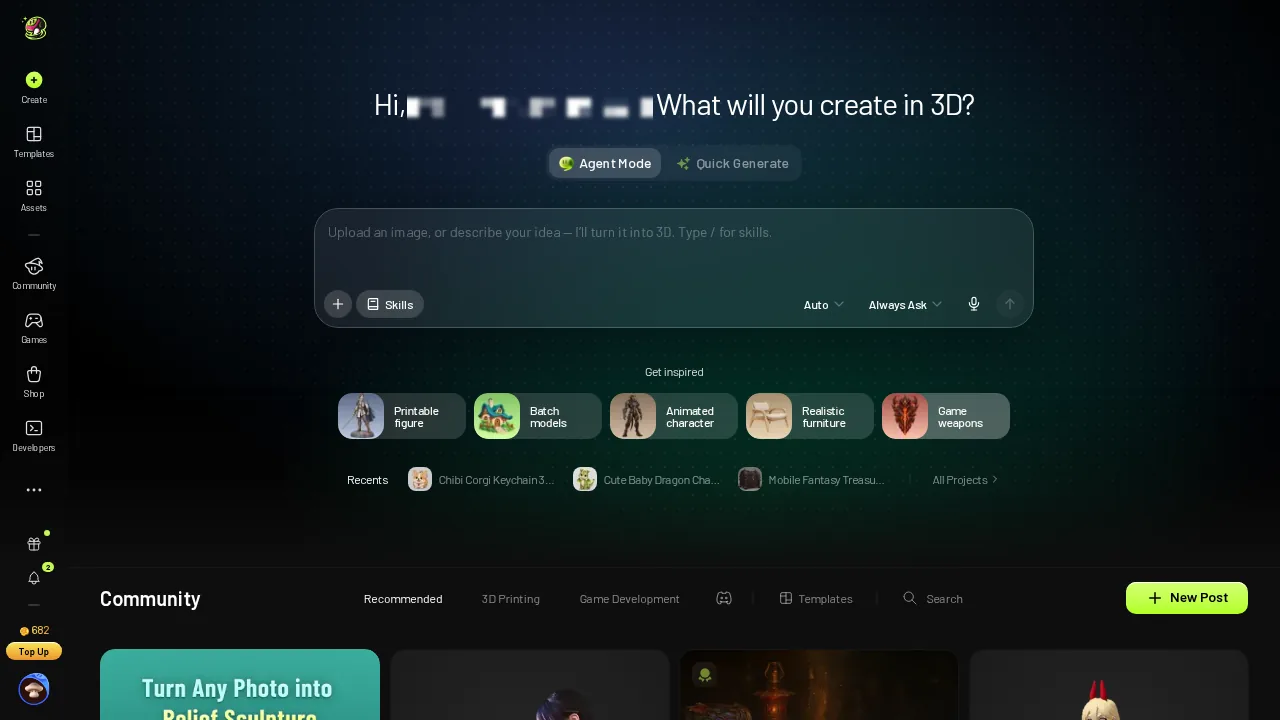 Meshy 3D Agent home before the test.
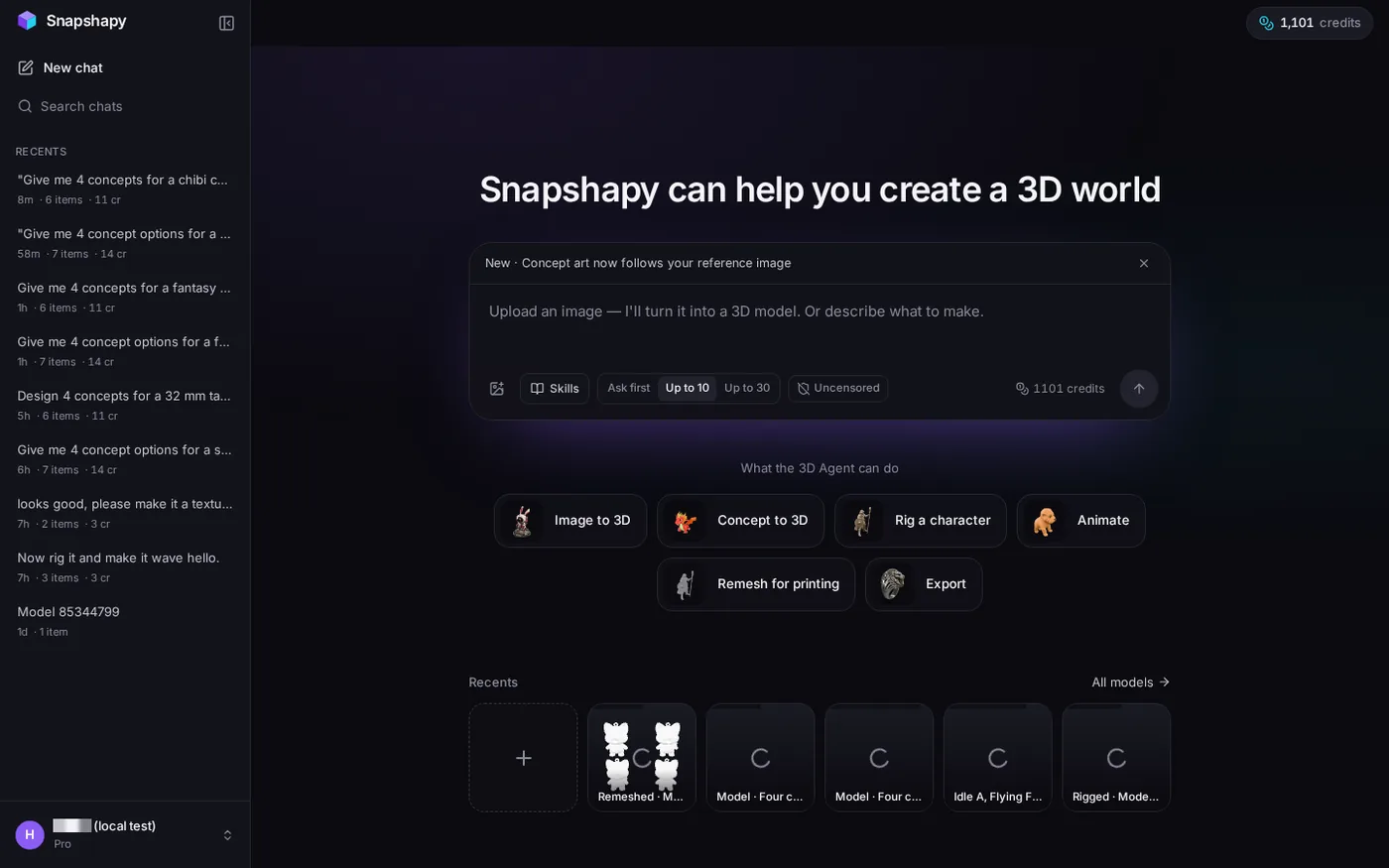 Snapshapy 3D Agent home before the test.
- Balance — Meshy 682 → 673 → 631 → 631 → 621 · Snapshapy 1,101 → 1,093 → 1,090 → 1,087, and an unchanged balance on the next-day print step (header "14 spent")
- Message 1, concepts — Meshy -9 · Snapshapy -8
- Message 2, textured model — Meshy -42 · Snapshapy -3 · 14×
- Message 3, rig, run and jump — Meshy 0 · Snapshapy -3
- Message 4, 15 cm print file — Meshy -10 · Snapshapy 0
- Total — Meshy 61 · Snapshapy 14 · 4.4×
Snapshapy's chat header kept its own tally and read "14 spent" at the end, matching my sum. The 42-credit Meshy drop on message 2 is the one to open up: it is two charges, and the smaller one pays for a step no explorer needed.
The explorer line by line: 9, 12, 30, 0, 10
Split by what was bought, the Meshy bill has five lines and the Snapshapy bill four.
- Concepts — Meshy 9 credits for 1 image · Snapshapy 8 for 4 · 9 vs 2 per image, 4.5×
- Cut-out of the character — Meshy 12 · Snapshapy no such step
- Textured 3D model — Meshy 30 · Snapshapy 3 · 10×
- Remesh, rig and motions — Meshy 0 · Snapshapy 3
- Print preparation — Meshy 10 for the repair · Snapshapy 0 for the print remesh
At list prices the five Meshy lines come to $0.18, $0.24, $0.60, $0 and $0.20; Snapshapy's four on Starter come to $0.38, $0.14, $0.14 and $0. The Meshy 3D step is 49% of the total and the cut-out another 20%, so two lines inside one message hold 42 credits, 69% of the bill.
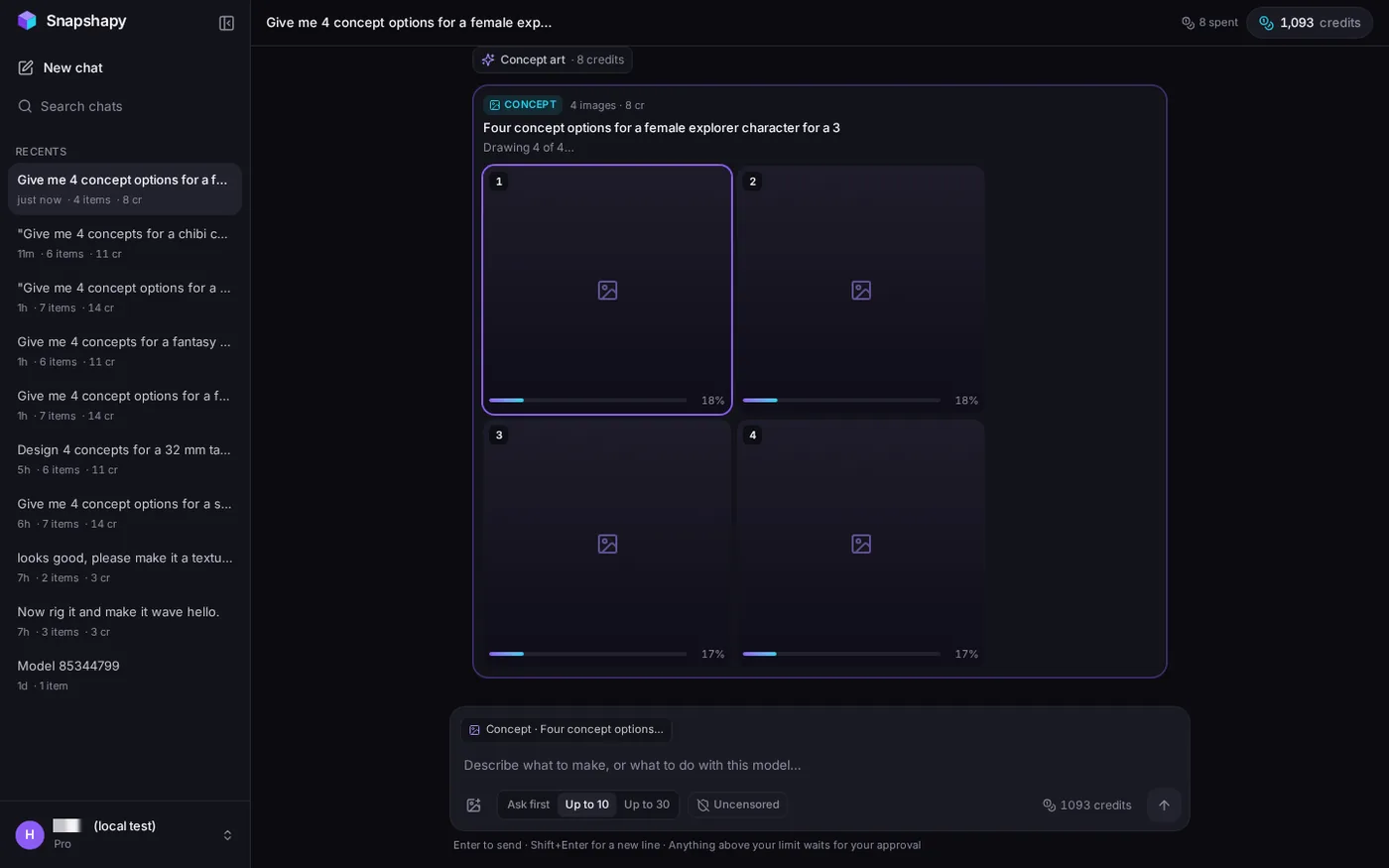 Snapshapy's reply to message 1: four explorers drawing, 8 credits.
The most expensive Snapshapy line, 8 credits for four concepts, is cheaper than the cheapest paid Meshy line, 9 credits for one.
The 12-credit cut-out Meshy charged for its own character sheet
Message 1 asked for "4 concept options for a female explorer character for a 3D platformer." Meshy's first answer was a choice card of four text directions with no pictures. I picked the first, approved it, and received one image for 9 credits: a Cybernetic Ruin Hunter laid out as a character sheet, with side insets and a companion drone.
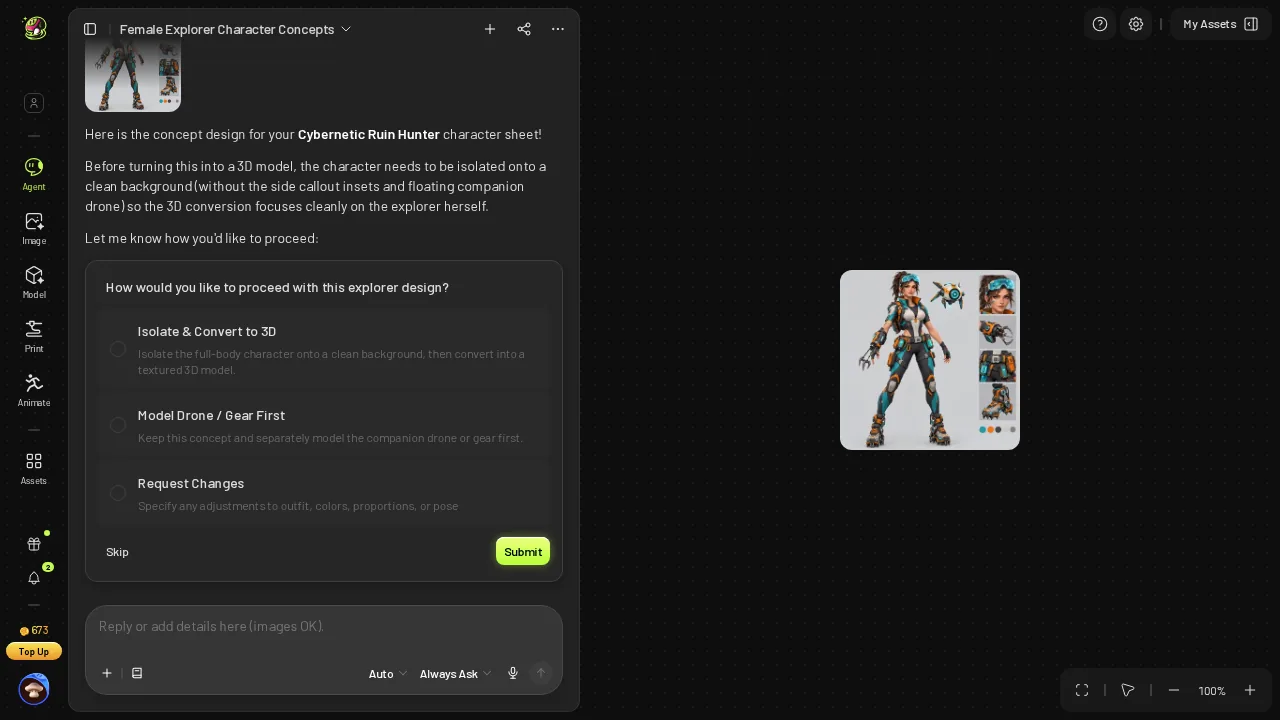 Meshy delivers one image, a character sheet, and says the character must be isolated before 3D.
That layout is where the 12 credits come from. When message 2 asked for a textured 3D model of option 1, Meshy said the character had to be isolated first and put an extra Image to Image step in front of the 3D job.
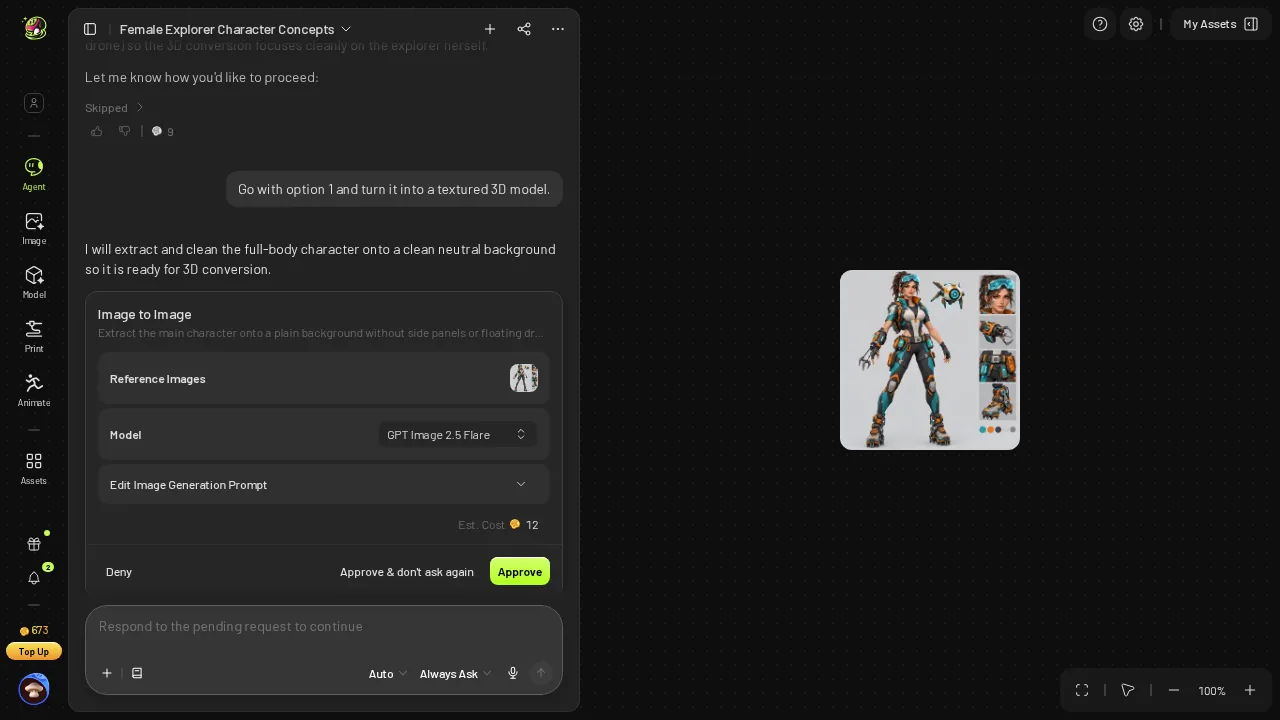 The extra Image to Image card that cuts the explorer out of the sheet, Est. Cost 12.
- Concept round, all-in — Meshy 21 credits ($0.42) for 1 character · Snapshapy 8 ($0.38) for 4 · 2.6×
- Single characters ready for 3D — Meshy 1, after the cut-out · Snapshapy 4
Snapshapy drew four separate single characters: a jungle explorer, a glacier mountaineer, a ruins scavenger and a balloon aviator. Option 1 went straight into 3D for 3 credits, because there was nothing to isolate.
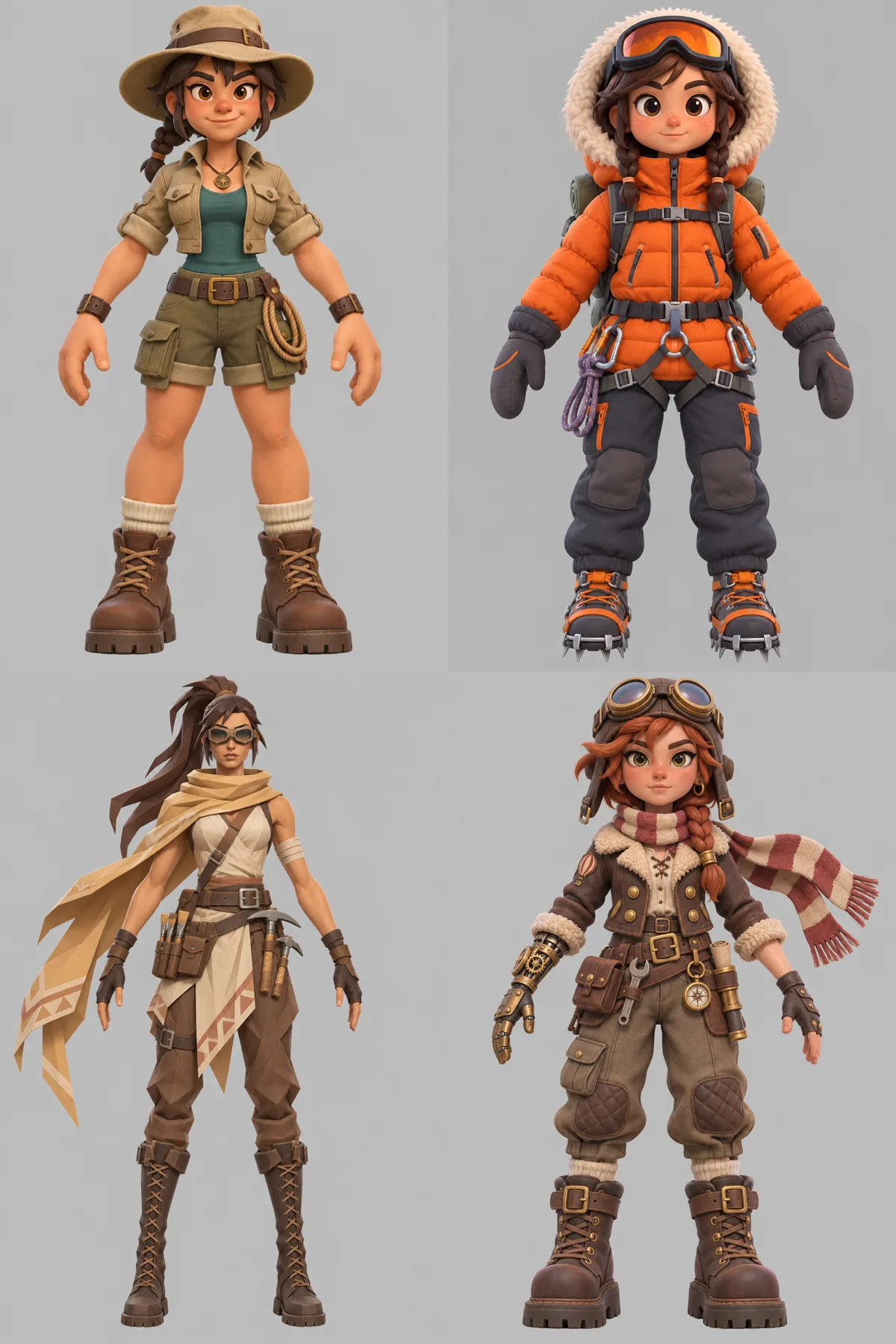 Snapshapy's four single-character concepts in a 2×2 grid.
The cut-out is a charge for a problem the Meshy concept step created. I asked for four options, got one, and the one arrived in a format the next step would not take, so I paid 12 credits to convert it. That is $0.24 per character, every time Meshy draws a sheet instead of a figure.
Est. Cost 12, 30 and 10: the cards that announce 52 credits
Credit where it is due: Meshy prints the price before it spends. The cut-out, image-to-3D and print repair cards each carried an Est. Cost line, and the balance moved by exactly that amount.
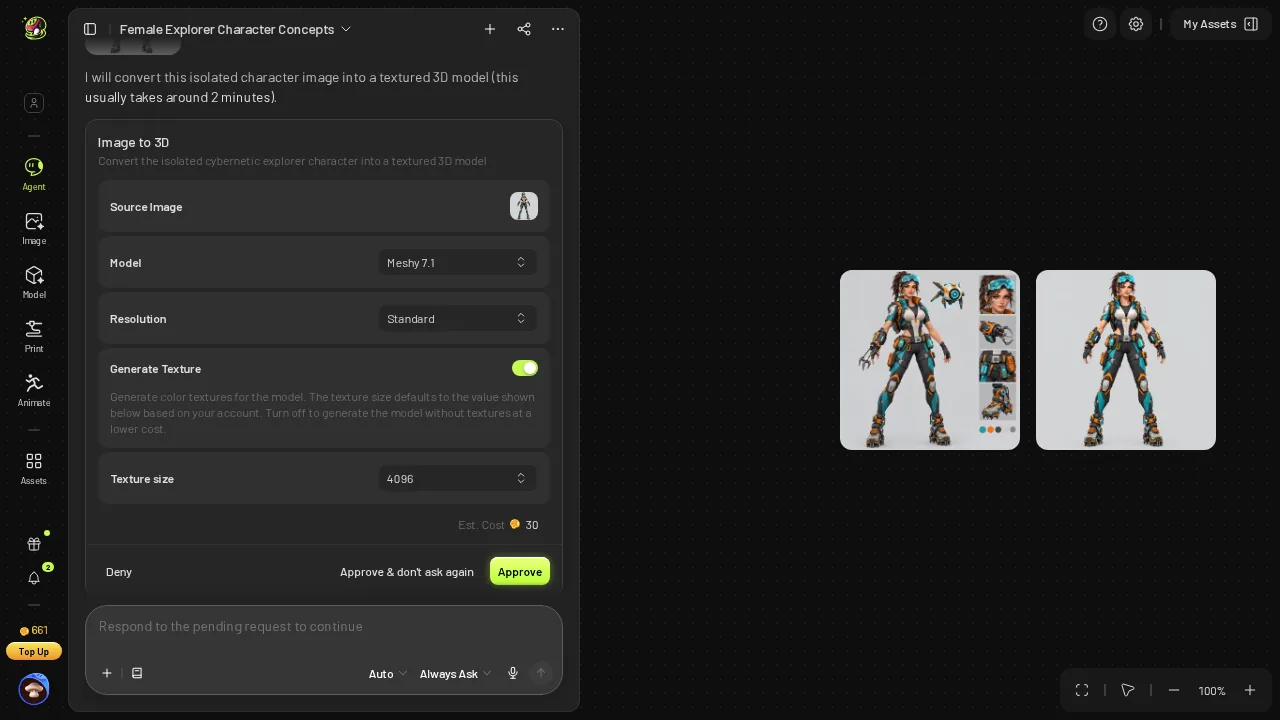 The image-to-3D approval card: Meshy 7.1, Standard, 4096 texture, Est. Cost 30.
- Announced on those three cards — 52 of 61 credits, 85% of the bill, $1.04 of $1.22
The cards make the bill readable, not smaller, and each one is a stop: read, click Approve, wait. The Meshy run asked for 5 Approve clicks in all. Snapshapy showed no approval card; its replies named the price in the text, 8 credits for the concepts and 3 for the rig and motions, and the job started.
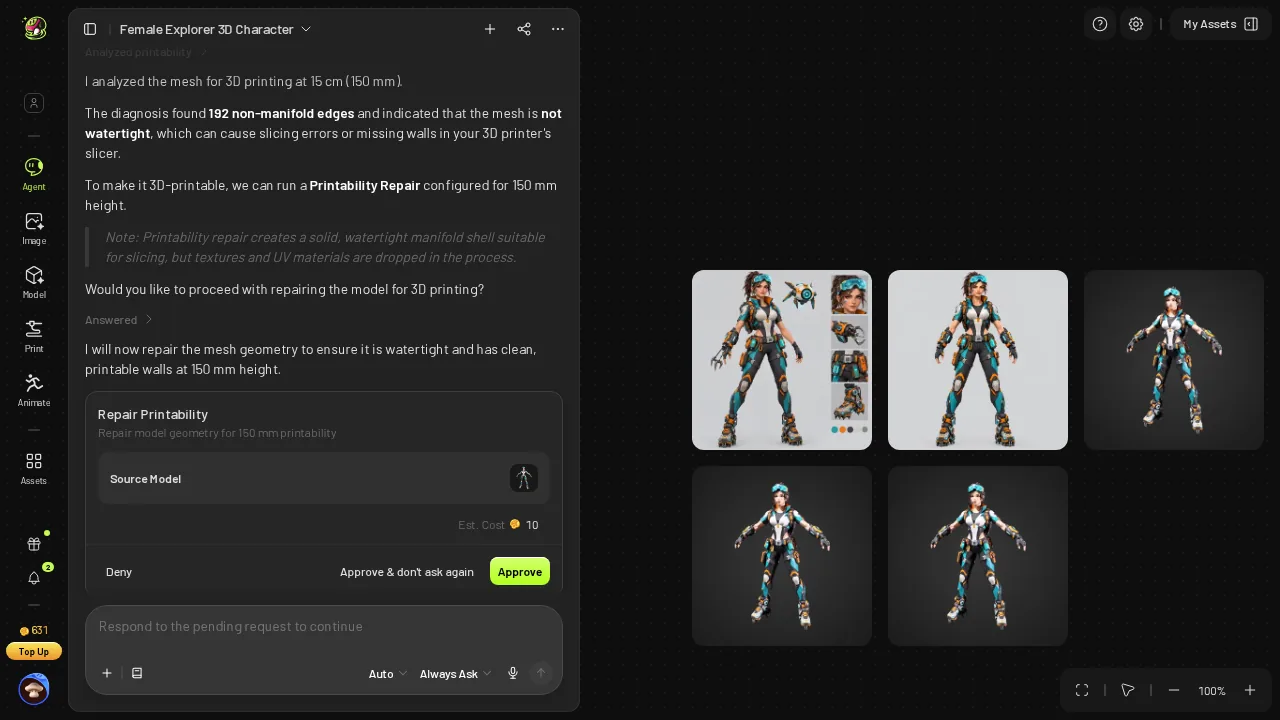 The print repair approval card, Est. Cost 10.
A 10-credit repair that outprices Snapshapy's rig, motions and print
Message 4 was "Now give me a file I can print at about 15 cm." Meshy checked the mesh, reported it as not watertight, offered a choice card, then charged 10 credits and about 75 seconds for the repair. Meshy's rig, remesh and motions cost 0 credits, and its free diagnosis caught 192 non-manifold edges before the repair.
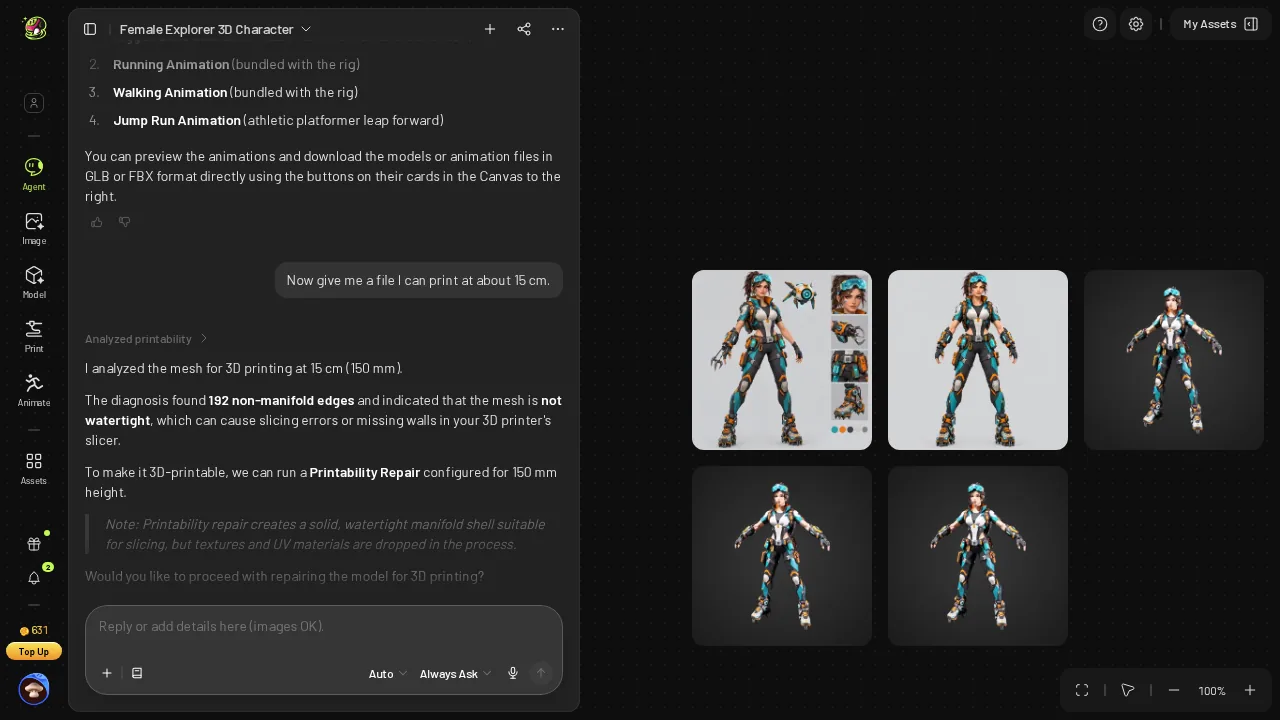 Meshy's print diagnosis, run before any charge.
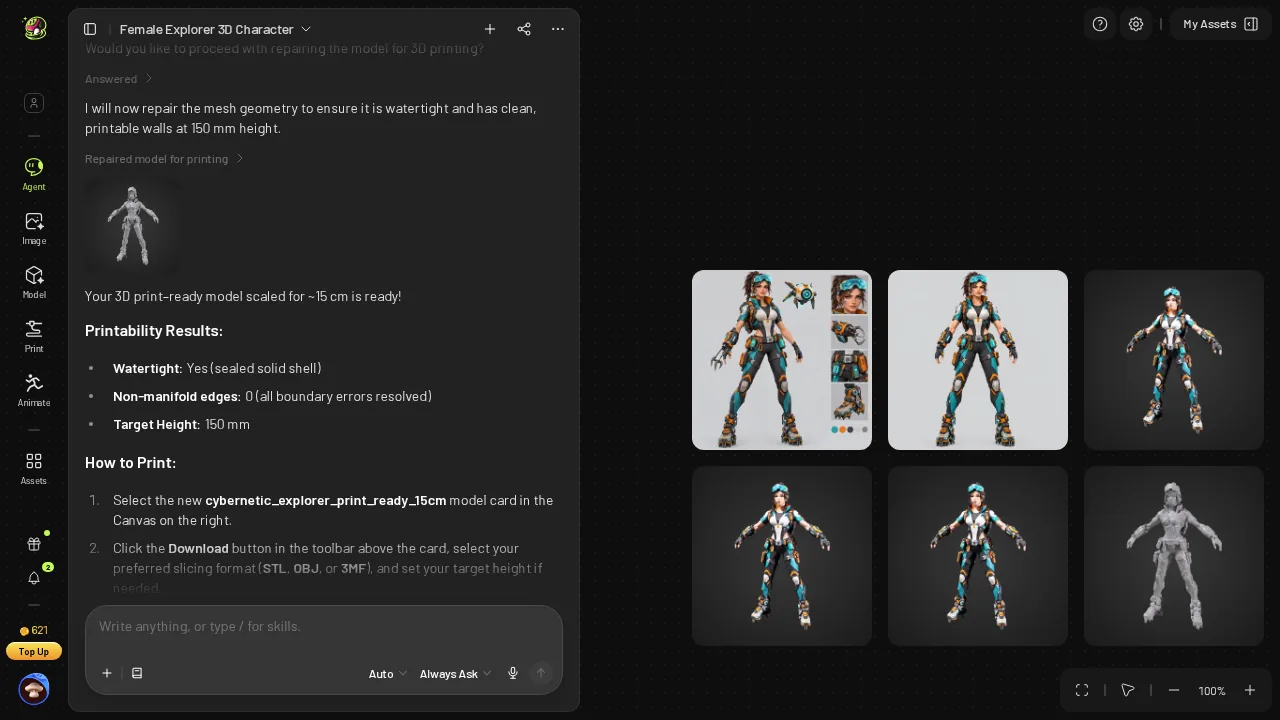 After the 10-credit repair: Watertight Yes, 0 non-manifold edges, Target Height 150 mm.
Snapshapy answered the same message in one line: "Reran the print remesh with the height set to exactly 150 mm, so the STL/3MF will export at 15 cm tall with no slicer scaling — free". The job took 7.5 s.
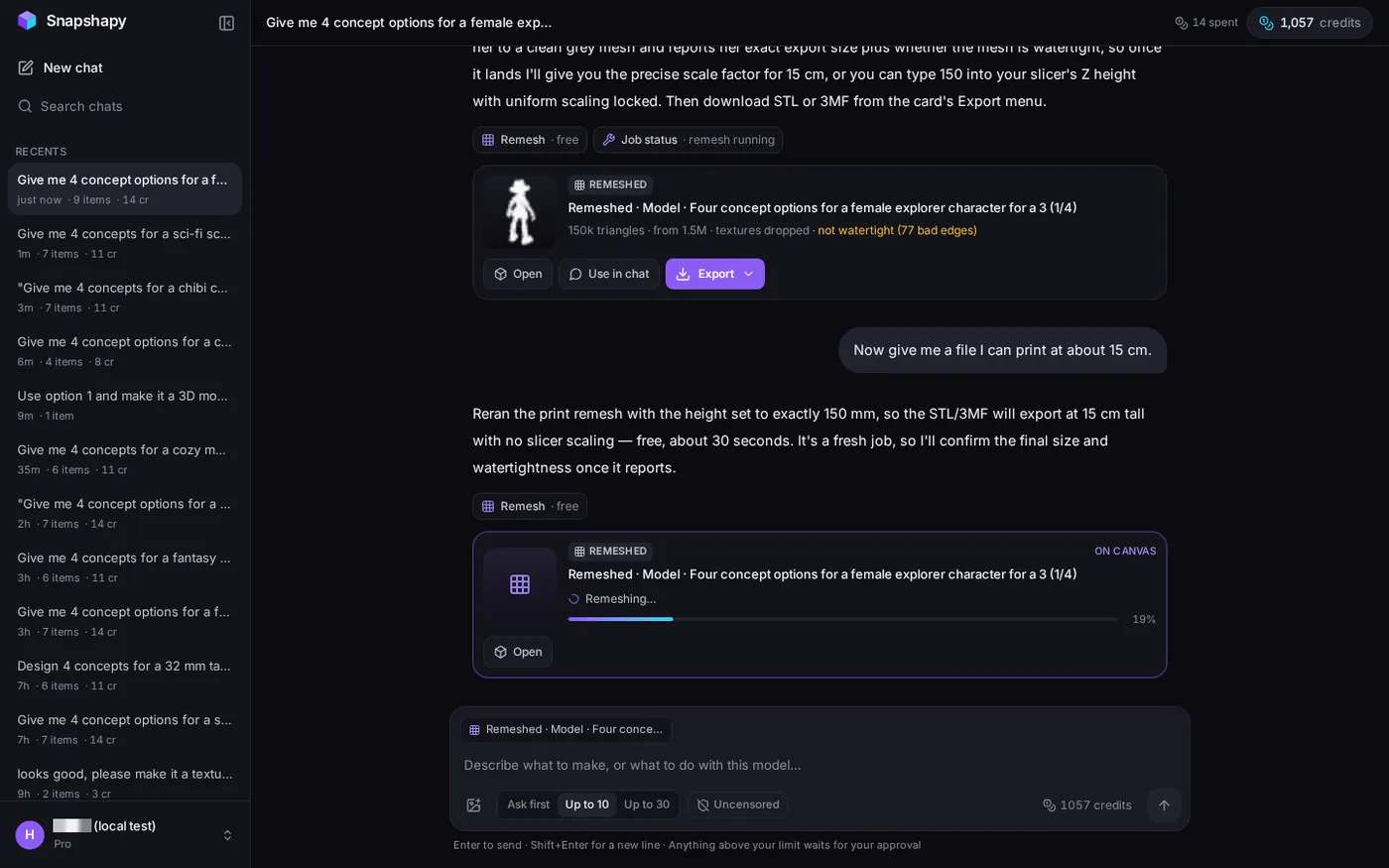 Snapshapy's reply to the print message on the next-day run: height set to exactly 150 mm, free.
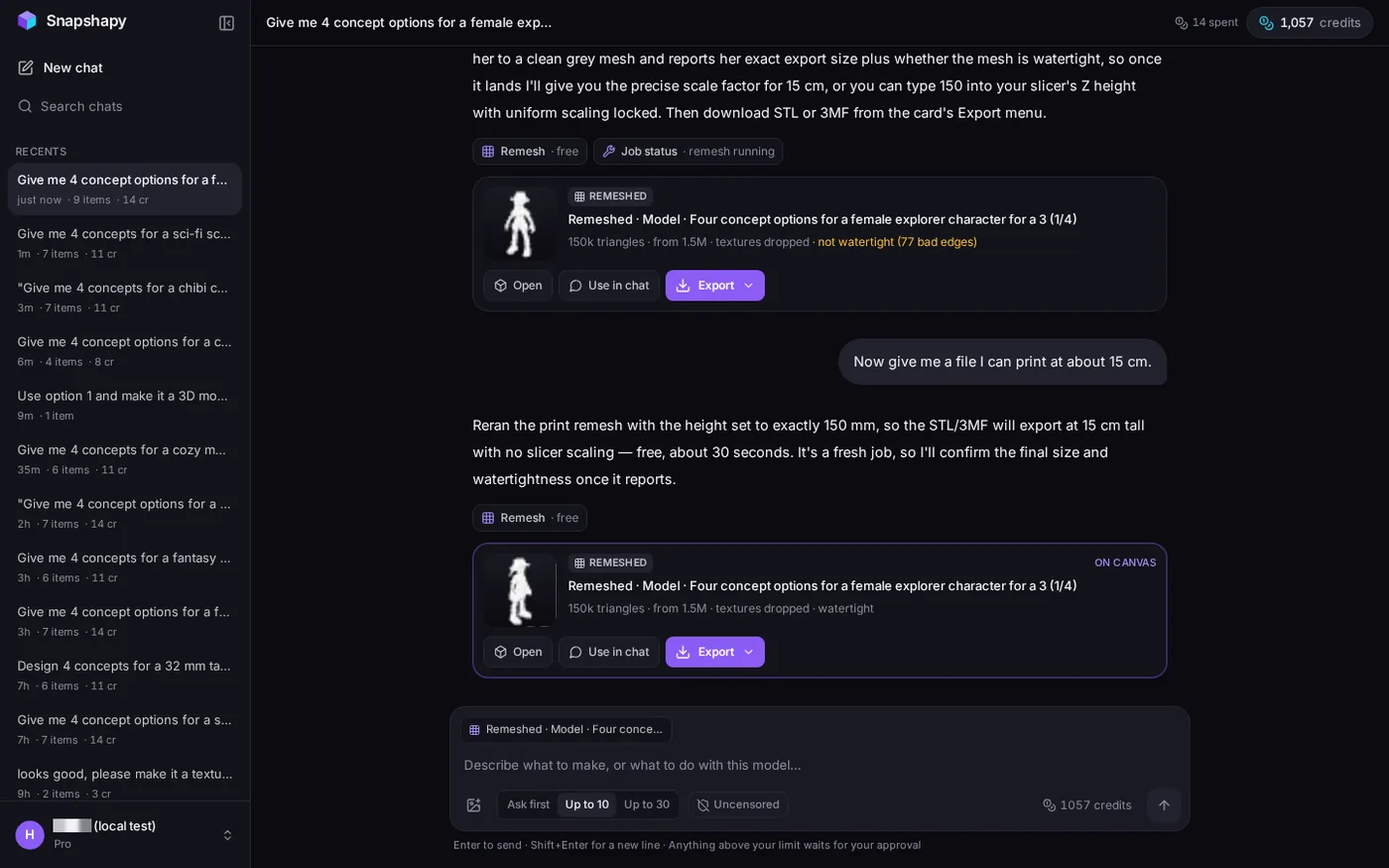 The lower card, done: "150k triangles · from 1.5M · textures dropped · watertight".
- Print step — Meshy 10 credits ($0.20) · Snapshapy 0
- Snapshapy rig, motions and print combined — 3 credits ($0.14) · Meshy repair alone 10 · 3.3×
- STL size — Meshy 50.0 MB · Snapshapy 7.5 MB · 6.7× smaller
My mesh tool measured both STLs as watertight, one body, 0 non-manifold edges, 150.0 mm tall. Meshy's STL is the denser mesh, 1,000,000 faces at a 0.228 mm mean edge against 149,844 faces at 0.637 mm. For a 15 cm figure, the 10 credits bought a file of the same height and integrity as the free one, at 6.7 times the size.
$1.22 against 67 cents per explorer
- Per explorer — Meshy Pro 61 × $0.02 = $1.22 · Snapshapy Starter 14 × $0.0475 = $0.67 · Snapshapy Pro $0.68
- Gap — $0.55 against Starter, $0.54 against Pro
The cheaper credit does not rescue the total because Meshy spends 4.4× as many. To match $0.67, Meshy would have to finish the explorer in 33 credits, and its 3D step alone takes 30.
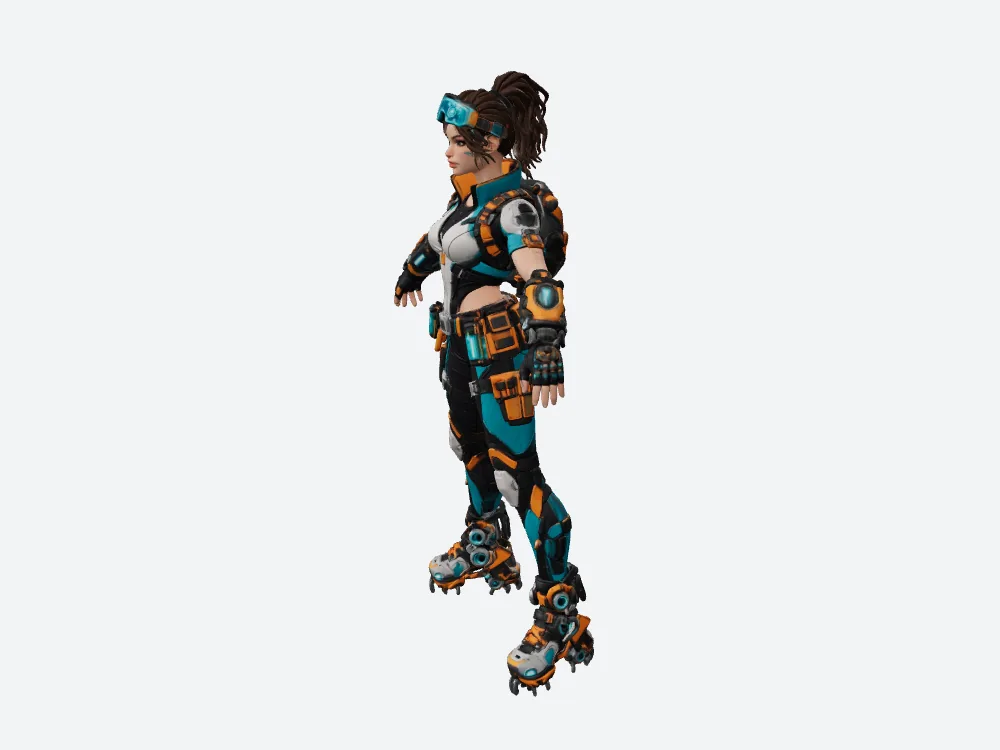 My render of Meshy's textured explorer, 1,867,328 triangles: the model behind the 30-credit line.
The static models weigh about the same: 1,867,328 triangles and 82.4 MB against 1,499,934 triangles and 83.7 MB. The price does not. That textured model cost $0.60 on Meshy and $0.14 on Snapshapy Starter, and on Meshy it only started after $0.42 of concept and cut-out work.
16 explorers a month on Meshy Pro, 28 on Snapshapy Starter
- ~$20 plan — Meshy Pro $20: 1,000 / 61 = 16 · Snapshapy Starter $19: 400 / 14 = 28 · 1.75×
- Snapshapy Pro $29 — 600 / 14 = 42
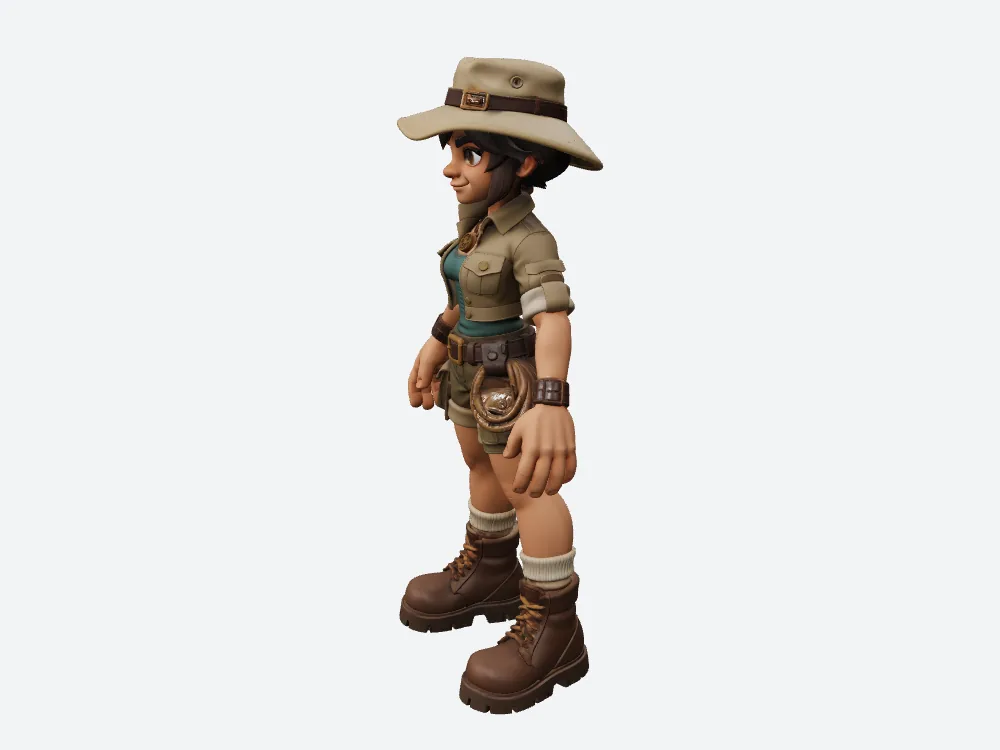 My render of Snapshapy's textured explorer, 1,499,934 triangles.
The two avoidable Meshy lines, 12 for the cut-out and 10 for the repair, add 22 credits per explorer. Over 16 explorers that is 352 credits, $7.04 of a $20 month. Strip both and each explorer costs 39 credits, so 1,000 would cover 25.
A 12-character platformer cast, in plain arithmetic
A platformer needs more than a hero, so here is the single measured run multiplied by twelve. This is arithmetic, not a second test: same messages, same prices, same choices.
- Credits — Meshy 732 · Snapshapy 168 · 4.4×
- Dollars — Meshy $14.64 · Snapshapy $7.98 on Starter, $8.12 on Pro
- Cut-outs and repairs — Meshy 144 + 120 = 264 credits ($5.28), 36% of the cast bill · Snapshapy 0
- Approve clicks — Meshy 60 · Snapshapy 0
- Headroom left in the month — Meshy Pro 268 credits, room for 4 more · Snapshapy Starter 232, room for 16 more
For motions, Snapshapy split the jump into Jump Start 1.67 s, Jump air 3.12 s and Jump Land 1.58 s, with Run Female 0.83 s, in one file for 3 credits per character, 36 for the cast.
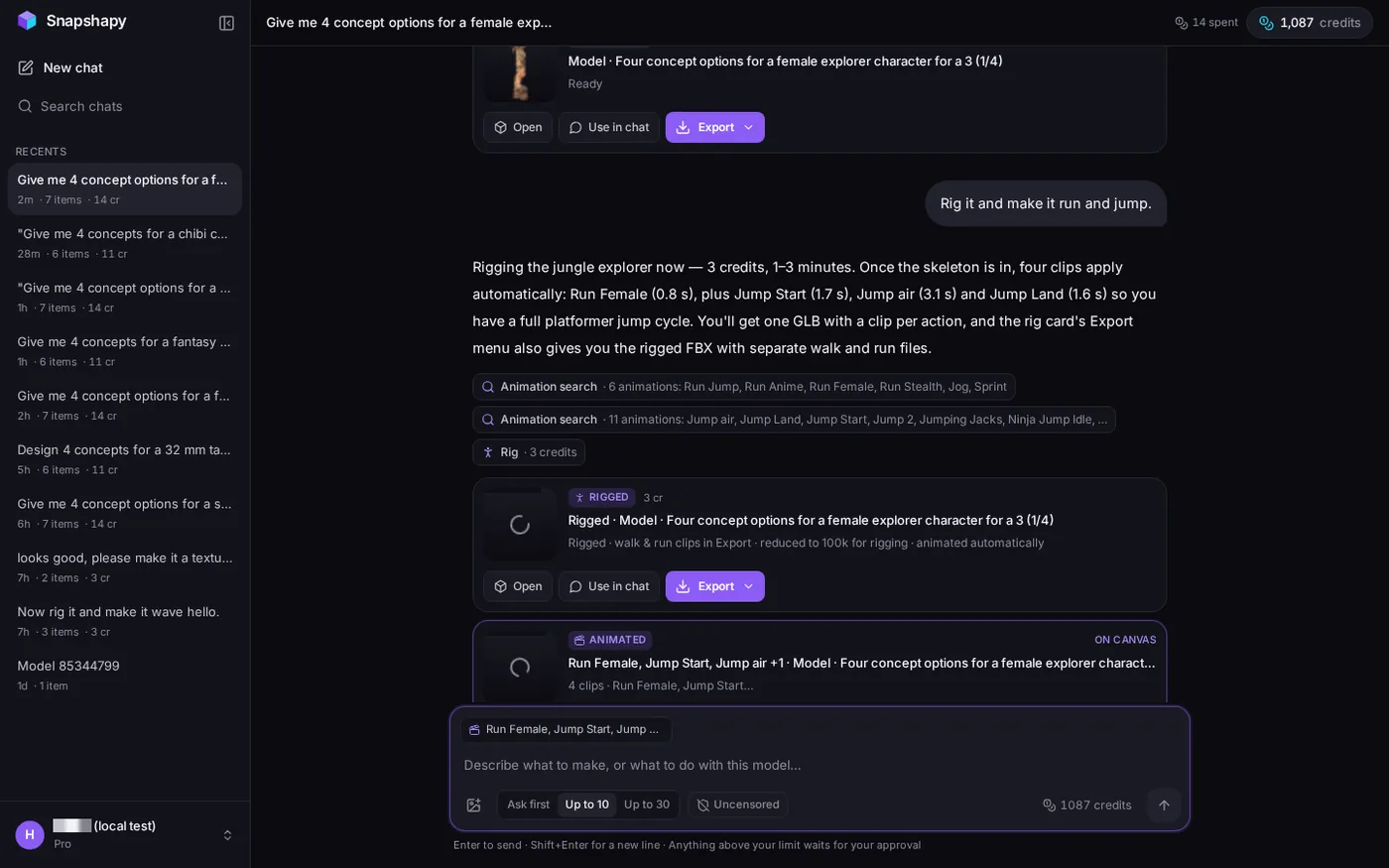 Snapshapy's rig card: "reduced to 100k for rigging · animated automatically".
The Meshy file carried Running 0.63 s, Walking 1.03 s and Jump Run 2.03 s in one download. The Meshy cut-out, 3D and repair lines are the ones that multiply.
Not on the invoice: 21 clicks and one refused rig
Two costs never touch the balance. The first is clicks: about 21 beyond the four messages on Meshy (3 choice cards, 5 Approve, 4 in the rig flow, 6 in the download dialog) against 2 on Snapshapy, Export → STL. For the cast, that is about 252 clicks against 24.
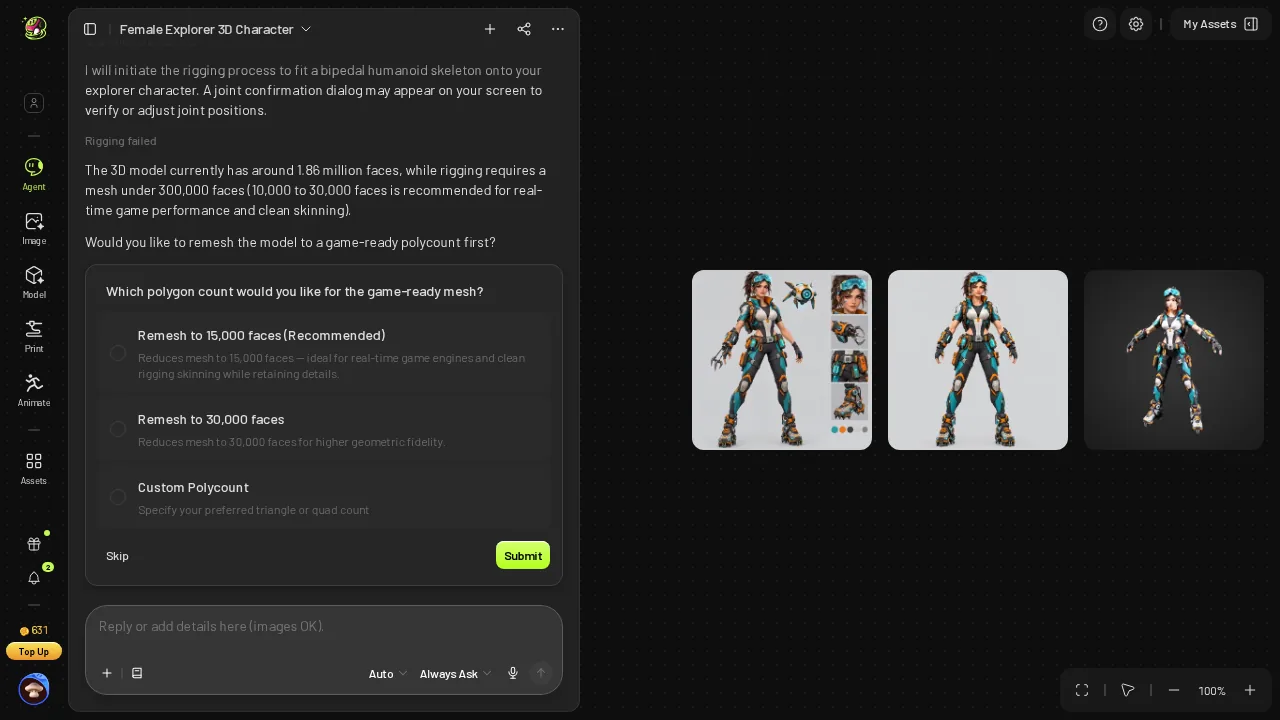 "Rigging failed": 1.86 million faces against a 300,000 limit, then a remesh choice card.
The second is the rig refusal. Meshy's rigger rejected Meshy's own model at "around 1.86 million faces, while rigging requires a mesh under 300,000 faces", so I had to pick a remesh first. Snapshapy reduced to 100k itself and rigged on the first try. Meshy was quicker on one job: image-to-3D finished in about 142 s against 247 s. And the download dialog opened at 12.00 cm with Resize off, so I set 15 cm by hand.
Final verdict: Meshy 3D Agent scores 56/100 for a platformer character
Read line by line, the Meshy bill for one explorer is 9 credits for one concept where four were asked, 12 to cut it out of Meshy's own sheet, 30 for the model and 10 to repair it for print: 61 credits, $1.22, 16 explorers a month. Snapshapy charged 14 credits, $0.67, 28 a month on Starter, and its rig, motions and print file together cost 3 credits, less than the repair alone. The Est. Cost cards are honest, but a pricing review scores the total, and the total is 4.4×.
Which one I would use for this job
For a female explorer, or a whole platformer cast, that has to run, jump and end up on a print bed at 15 cm, I would use Snapshapy at snapshapy.com. Four concepts cost 8 credits, the model 3, the rig and motions 3, and the print file nothing.